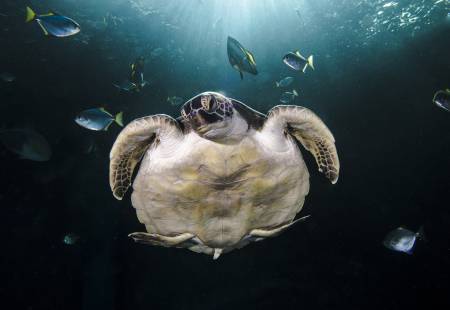

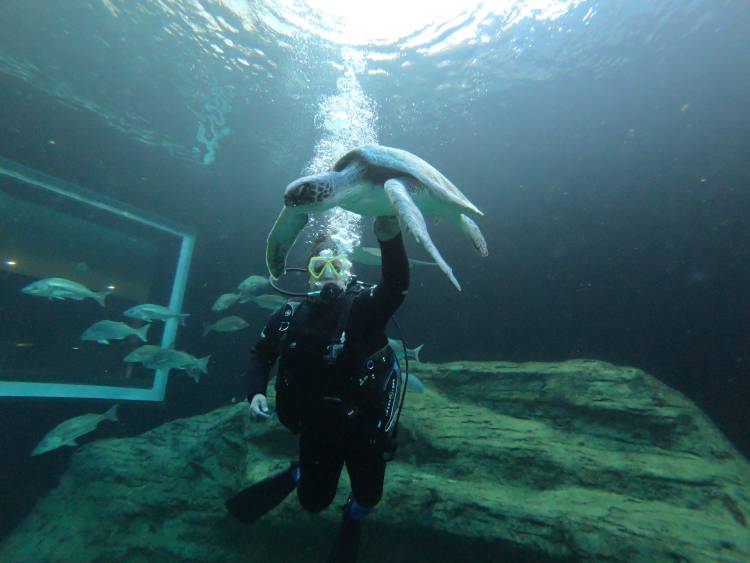
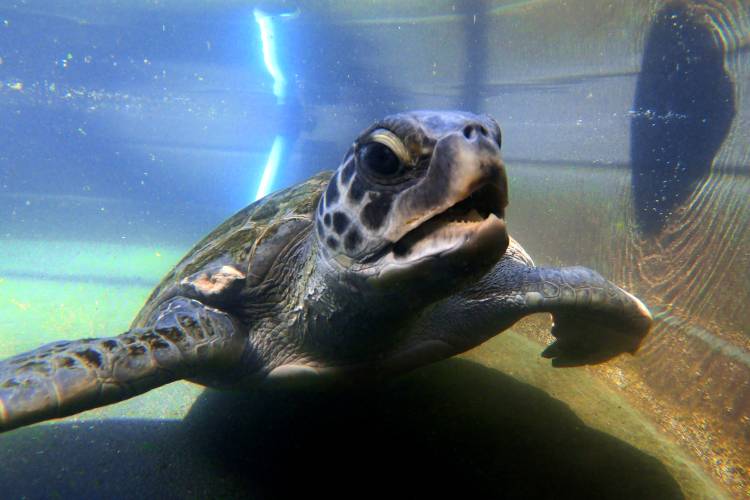
It's official - Bob and Sandy have a turtally gorgeous new friend in the I&J Ocean Exhibit at the Two Oceans Aquarium!
Since her rescue, Moya has been out of the public eye - residing in our turtle rehab centre. Aside from a few short updates, you may be wondering where this precious lady has gotten too. Well, wonder no longer - Moya has officially joined fellow green sea turtles Bob and Sandy in the I&J Ocean Exhibit!
She may have been a little cautious at first - but Moya is now clearly in charge of her own little cave.
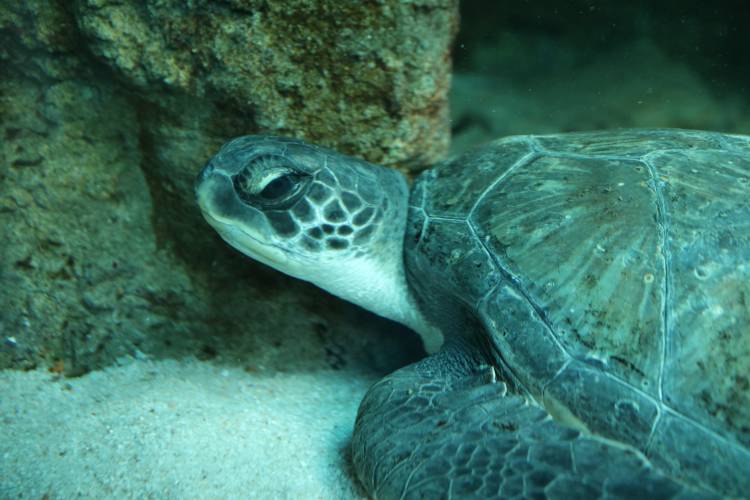
All Moya needed was a familiar face to help her get some confidence and make some new friends (like a kid's first day at school).
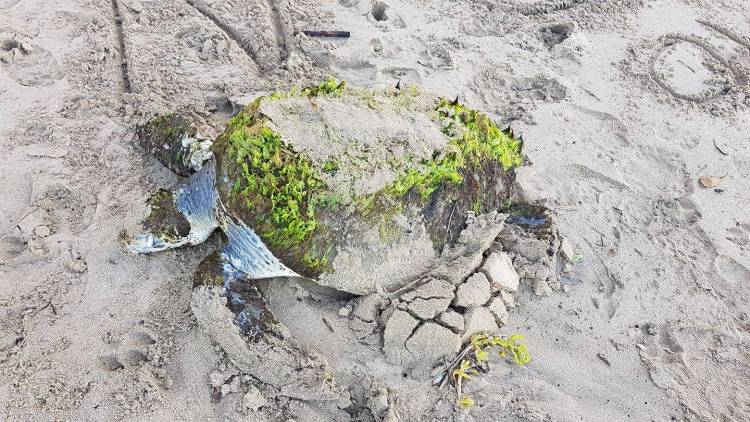
Moya was quite a celebrity when she arrived at the Two Oceans Aquarium in October 2017 - her rescue was an epic story of teamwork that involved a pair of dogs, a determined citizen, two teams of veterinarians and an airline! This incredible rescue was truly an inspiration, making the headlines, and encouraging the Two Oceans Aquarium to embark on the Turtle Road Trip and form the Turtle Rescue Network, where everyday citizens work together to save stranded turtles.
Why has she been moved?
When Moya arrived in October 2017, she was weak, dehydrated and had a nasty-looking flipper injury. Turtle rehab centre staff started her treatment with a course of antibiotic and antifungal medications, thinking that an internal infection may have been the cause of her poor health. Turtle metabolisms are quite slow and their digestive systems become particularly slow if they’ve been floating for a long time due to some distress. This seemed to be the case with Moya - even after weeks in our care, she wasn’t pooping at all.
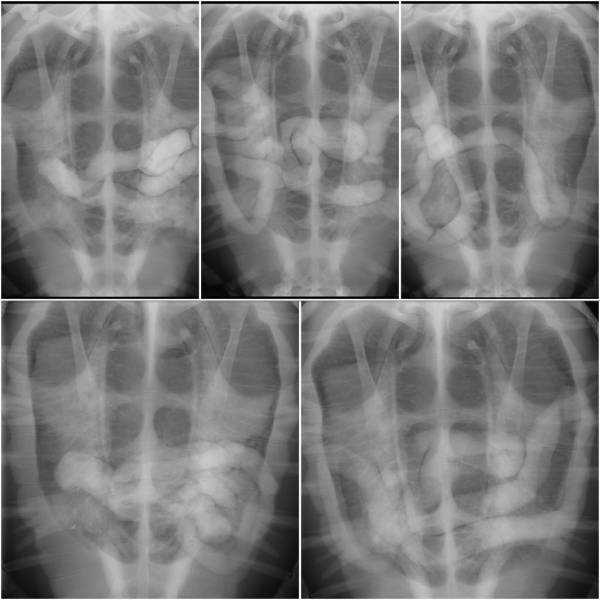
We grew quite concerned about this and X-rayed her to find out more. It turned out that Moya had impaction; her gut wasn’t working properly so nothing was moving. We thought this may have been caused by a blockage. An X-ray contrast study was started and she was taken for an MRI scan. No clear obstruction was revealed, and Moya started pooping soon after that - we thought she was out of the woods.

However, in late February, Moya again stopped pooping. After another MRI and contrast study, it was determined that she had air bubbles in her gut, this was due to a lack of peristalsis (the movement your intestines make to push things along). Even though she had started pooping after the previous scans, her intestines were still struggling to recover.
We responded by changing her diet; feeding her small amounts of protein and high volumes of roughage - lots of sea lettuce and some crunchy prawns and crabs.
This had the desired effect. Moya is pooping again (yay), we are very happy with her progress. We are still feeding her a high roughage diet but are slowly increasing the amounts of protein she receives.
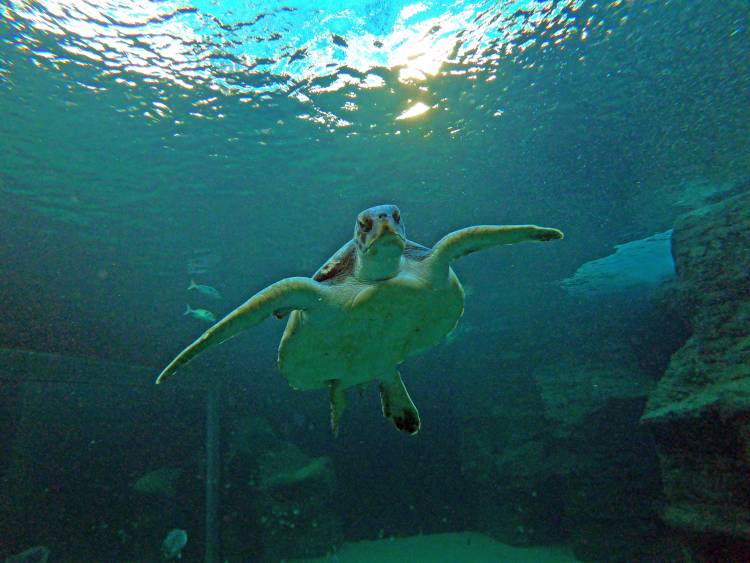
We are excited for Moya to join Bob and Sandy in the I&J Ocean Exhibit - this will allow her to have greater freedom and stimulation while allowing us to observe her for long enough to be confident her intestinal issues are healed (she won't get a special diet back in nature). She is a gentle and coy soul with a beautiful smile and like her rescue buddies Bob and Sandy, she LOVES a good back-scratch!
How can you help?
Green sea turtles, together with loggerheads, leatherbacks and the occasional hawksbill turtle, are all threatened species that need our help to survive in South Africa's waters. Here are a few ways that you can help them, and other animals, to have a fighting chance:
- If you live in the Western Cape, here's what to do if you find a stranded sea turtle.
- The turtle rehab-and-release centre at the Two Oceans Aquarium requires around-the-clock attention, specialised medical care and many extra man- and woman-hours. To help us do this life-giving work, please consider making a donation online by clicking here.
- Choose sustainable seafood - many turtles are killed as bycatch in unsavoury fishing practices. Use the WWF SASSI app to identify types of seafood that are environmentally sustainable.
- Take part in beach cleanups.
- Lastly, rethink your relationship with single-use plastic items, such as plastic shopping bags and drinking straws. Pick a reusable alternative - these simple items are devastating ocean ecosystems.
_450_310_70_s_c1_c_t.jpg)