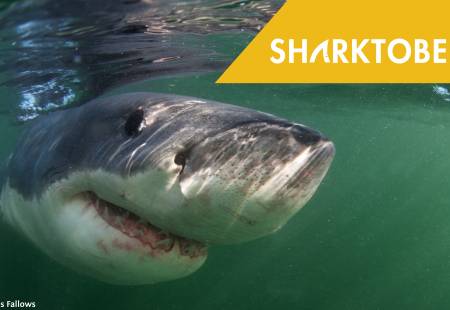

For us, seeing a shark in the water is certainly a sight to see! But how well do sharks actually see? How do they protect their eyes? And what is up with a hammerhead’s eyes? Let’s take a closer look at shark sight.
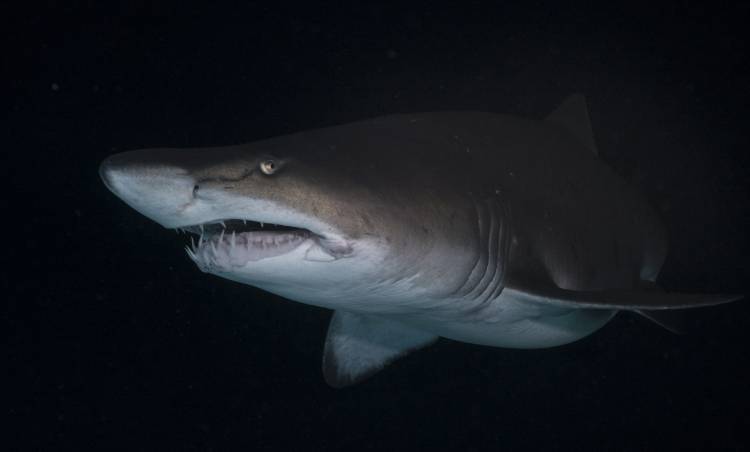
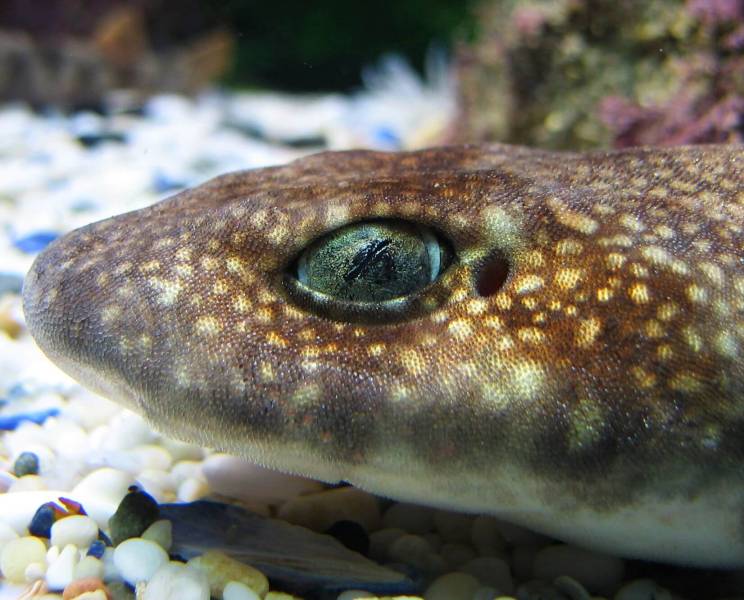
By all accounts, sharks have pretty impressive eyesight. As a matter of fact, it is estimated that shark sight is about 10 times better than what humans have in clear water. The structure of shark eyes is very similar to that of human eyes, comprising of a cornea, lens, retina, iris (which is a deep blue) and pupil. Also, just like human eyes, shark eyes have two types of photoreceptors: rods and cones. Rods are responsible for vision in low-light levels. Cones are more active at higher light levels and are capable of colour vision. We aren’t quite sure how well they perform this function in sharks or how exactly sharks perceive colour, but it does seem that they only have one type of cone, so do not have full colour vision like the human eye.
Shark eyes also have tapetum lucidum. This is a layer of mirrored crystals that is located behind the retinas. These crystals are highly effective in helping the shark see in very dim light and murky water. The crystals reflect incoming light which gives the rods in the retina a second chance at detecting light that it might have missed the first time around.
Did you know that your domestic cat and sharks have something in common? They both have tapetum lucidum. This is why your cat’s eyes glow in the dark when you shine a light on them.

In most cases, shark eyes are also protected by eyelids. They also have a thin, tough membrane, known as the nictating membrane that covers the eye and protects it from getting damaged, especially when the shark is feeding. White sharks lack this membrane, and therefore, to protect their eyes, they roll them back when they are hunting.
Did you know that whale sharks, just like white sharks, lack the protective eyelid and also roll their eyes back to protect them?
Sharks usually have eyes positioned on the sides of their head, giving them excellent peripheral vision, but this position creates two blindspots - one in front of its snout and one behind its head! To overcome this, sharks wave their heads from side to side or circle an object to keep it in view. This is also why sharks sometimes bump into objects like surfboards and kayaks – they literally cannot see objects that are right in front of them, so need to use sense organic in their snouts to investigate.
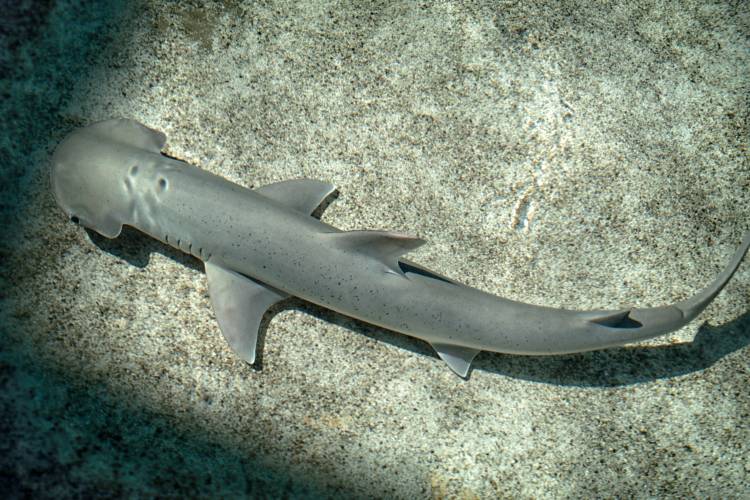
Finally, this brings us to the peculiar-looking hammerhead shark. For a long time, it was thought that, because a hammerhead’s eyes are placed so far apart, their line of sight didn't overlap and they would have a huge blindspot. Well, scientists have proven that the overlap in bonnethead sharks can be as great as 34 degrees, creating binocular or 3D vision. Hammerhead sharks can also increase their stereoscopic sight (where the visual field of the two eyes overlap), by rotating their eyes and moving their heads from side to side. Hammerhead sharks can effectively see above, below, in front and behind – 360-degree sight.
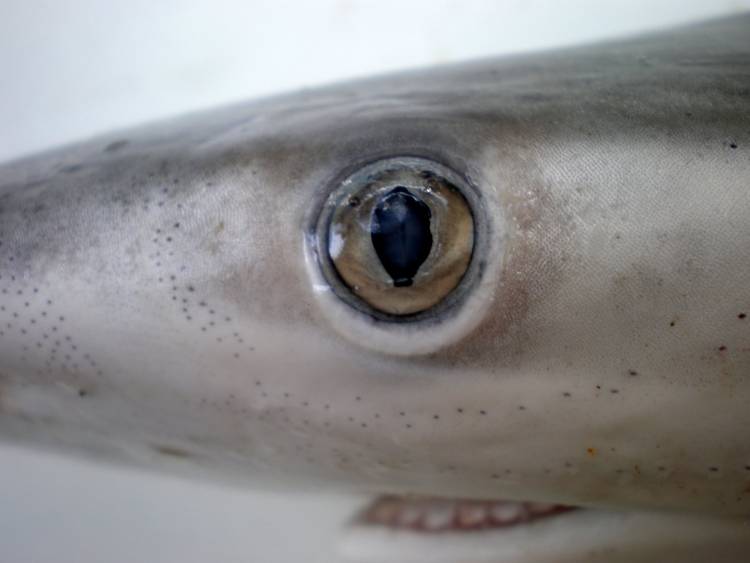
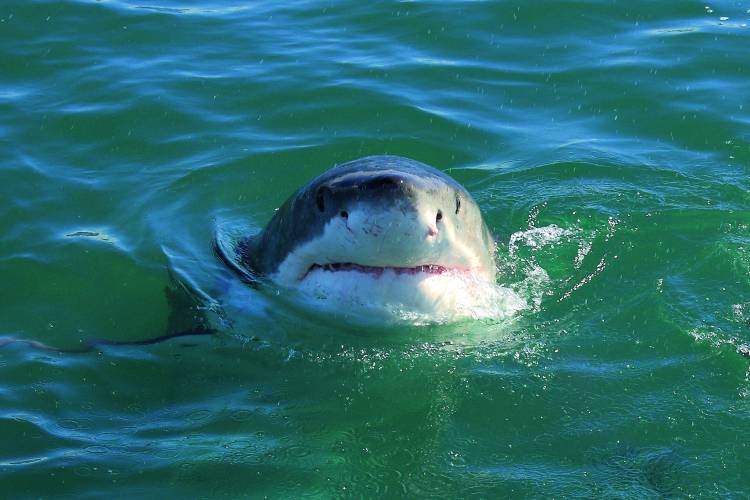
One last thing – shark pupils can dilate. When they are in low-light conditions, the pupils are large circles, letting as much light in as possible. But when a shark spyhops (sticks its head out of the water) or is looking upwards towards a well-lit surface, the pupils contract into slits, a lot like cats' eyes, to compensate for all that extra light. Regular bony fish eyes can’t do this party trick!
_450_310_70_s_c1_c_t.jpg)