
On the 22 May 2018, the Two Oceans Aquarium received a call from a member of the public who found a distressed sea turtle floating in the kelp near Lambert's Bay - immediately our aquarists and turtle rehabilitation team put plans in place to rescue this wounded animal, which was identified as a critically endangered hawksbill turtle.
Learn more about the Two Oceans Aquariums' turtle conservation programme.
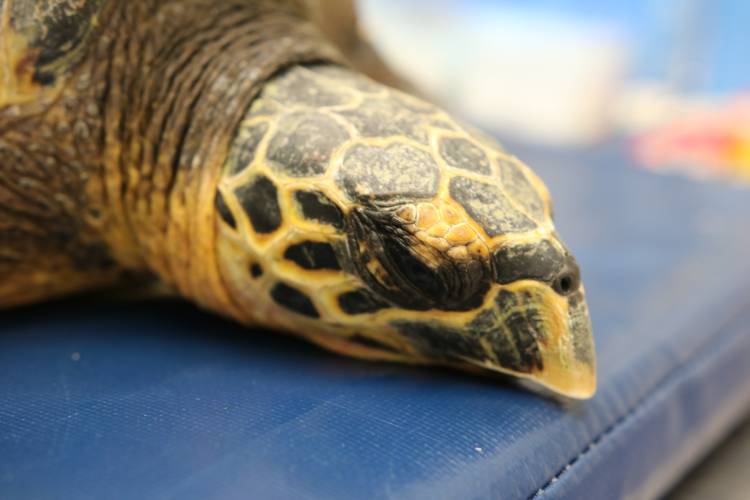
The turtle was rescued by Lambert's Bay local Dougie Leech who kept it at his home overnight, while Senior Aquarist Kevin Spiby and Collections Officer Deen Hill drove to Lamberts Bay to collect the turtle. They were able to collect the wounded turtle early the next day and return it to the Two Oceans Aquarium that afternoon - coincidentally amidst World Turtle Day festivities.

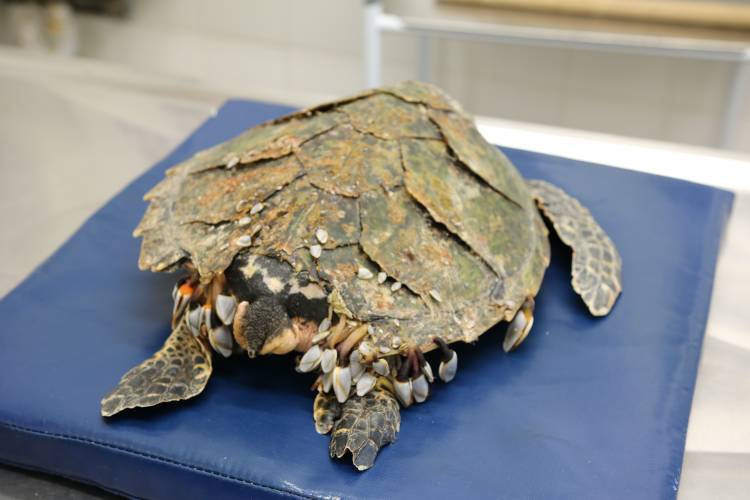
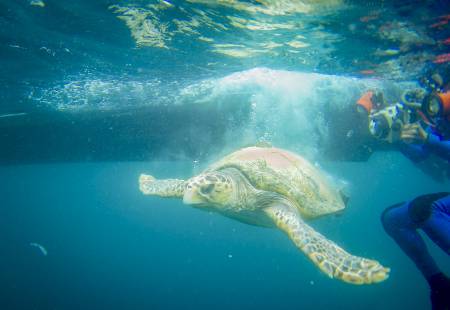
It was then time for veterinary staff to examine the turtle. A large portion of the back of its shell was missing, probably caused by a shark bite. It looked like the plates of its shell had been removed one by one - so we named her Jenga after the popular game.
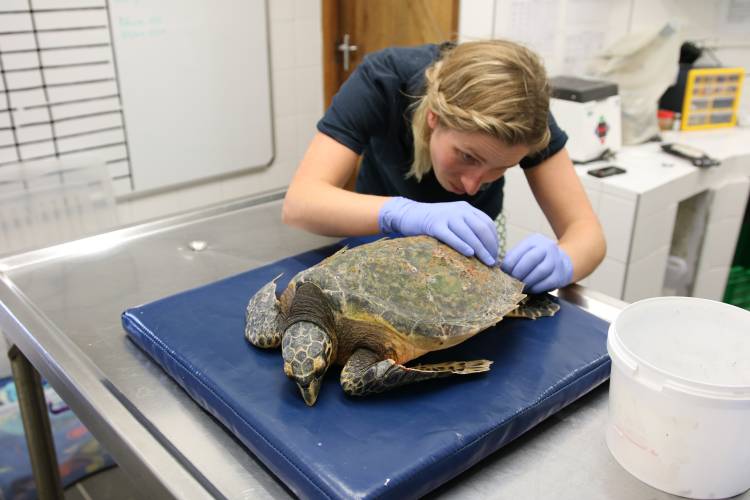
Jenga’s cloaca was also injured - covered in scar tissue and severely infected. Under our care, she received daily fluids, antibiotics, an array of vitamin injections. Slowly, but surely, she started perking up.
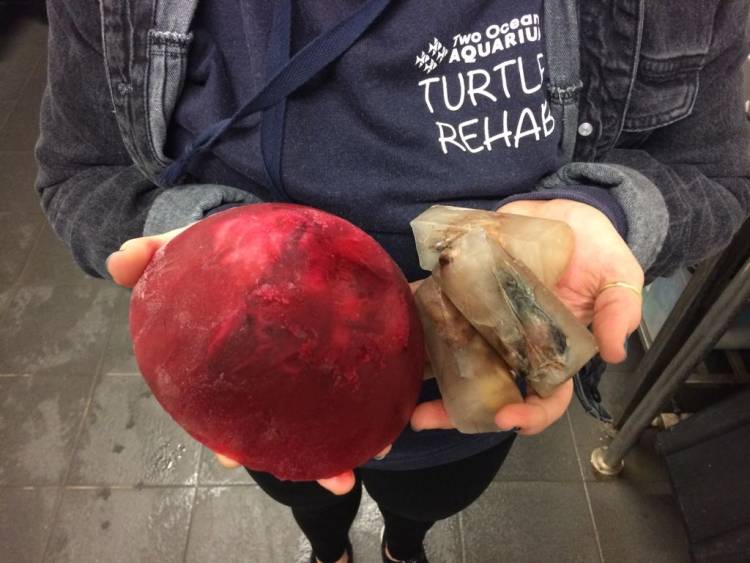
After a few weeks of healing up in our turtle rehabilitation centre, Jenga started showing interest in food. Initially, she was quite a picky eater and would only eat whole baby squid, but eventually, she started becoming curious about what else could be on the menu, and now eats almost anything that is offered to her.
Want to meet some of our rehab turtles for yourself? Come say "hi" to tiny Phiko or meet Bob, Sandy, Moya and Noci in the I&J Ocean Exhibit in your own special Ocean Experience.
We are trying to feed her innate curiosity and keep her busy and enriched throughout her day. She has a tunnel that she can hide in and swim through and a great little backscratcher to get to those hard-to-reach itchy spots. Her food is also taking different shapes and forms - sometimes we freeze it in different shaped ice blocks, let some of it float on the surface so she can chase it and tie some of it to the bottom of the tank so she has to forage for it.
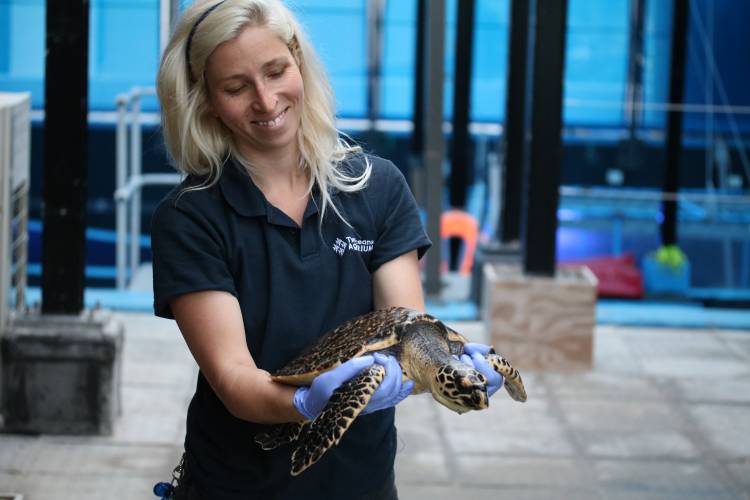
It is always thrilling to discover the personalities of turtles as they heal and start to feel a bit better in their temporary new home - Jenga is no exception. She really has proven herself to be a turtle marked by optimistic curiosity and enchanting beauty.
What is a hawksbill turtle anyway?
Hawksbill turtles (Eretmochelys imbricata) are one of the rarest species of sea turtle entering South African waters. They do not nest natively on our shores, and enter our waters only as strays, trying to find fertile sub-tropical feeding grounds filled with yummy crabs, prawns and sea sponges.
Here's everything you need to know about sea turtles in South Africa.
Their unique curved beak is used to eat sea sponges and corals - they have no problem feasting on these toxic sea creatures, often filled with glass spicules (tiny glass crystals). They are completely immune to all these poisons, and the stings of jellyfish and are, in fact, able to store these toxins in their flesh, making them toxic to predators. In fact, Jenga may only have been bitten by a shark because she strayed so far out of normal hawksbill territory - sharks in her native waters would have known to avoid her.
We rescue, rehabilitate and release dozens of turtles every year. Learn more by clicking here
Hawksbill turtles are critically endangered - thousands are killed annually for their "tortoiseshell", their eggs are harvested for food, they are eaten (despite being toxic to humans), their coral reef foraging ground habitats are being destroyed, as are their nesting beaches, and they are the species of turtle most susceptible to being caught on fishing hooks or in ghost nets.
_450_310_70_s_c1_c_t.jpg)
_450_310_70_s_c1_c_t.jpg)