
You may have seen the news - a pod of four false killer whales was recently spotted in the harbour at the V&A Waterfront, and others have been seen beached at Bloubergstrand and Koeberg. Assisting the NSRI, the Department of Environmental Affairs and the City of Cape Town, the Two Oceans Aquarium is doing its part to ensure the safety of these beautiful, yet unusual, ocean visitors. Here's everything you need to know.
ALERT: 4 False killer whales, including a calf are currently swimming around boats at the @VandAWaterfront . 3 stranded whales were rescued from Blouberg yday. The DEA, @2OceansAquarium ,@NSRI and @CityofCT are monitoring them. Skippers encouraged not to stop near them for pics. pic.twitter.com/6B2LoBB7cR
— Environmentza (@environmentza) February 4, 2018
Status update - 8 February
A quick update: We have been informed by Sea Search, who have been assisting the Department of Environmental Affairs with the ongoing monitoring of the health of the false killer whales in the V&A Waterfront, that the whales are now out of the harbour thanks to a concerted effort made by boats and staff from the Two Oceans Aquarium, City of Cape Town, NSRI and DyerICT.


We'll post a final statement on the health and final status of these whales once all parties involved have finalized their reporting.
Status update - 7 February
This morning, eight craft from the Department of Environmental Affairs, Sea Search Research and Conservation, City of Cape Town Oceans & Coasts, NSRI, the Two Oceans Aquarium and volunteers again attempted to shepherd the false killer whales out of the harbour's Victoria Basin. Unfortunately, despite the use of additional boats and noise-making equipment, the animals did not leave the harbour. They are presently in a relatively isolated portion of the harbour near the exit.
Once again, the public and boat operators are reminded not to approach the false killer whales as the Department of Environmental Affairs continues to monitor the situation. As incredible as it is to see wildlife like this up close, please remember that these are large animals, weighing many tons and that they are in a stressful situation - their reactions to people are not predictable.
The Department of Environmental Affairs has released an official statement, and we urge others to please monitor their communications for updates.
_(Large)_750_536_70.jpg)
_(Large)_750_536_70.jpg)
_(Large)_750_536_70.jpg)
Status of harbour false killer whales - 6 February
On 4 February, a pod of four false killer whales were spotted in the waters of the V&A Waterfront. One appears to be an injured adult and at least one other is a young calf. It is believed that these are the same false killer whales that were beached and subsequently rescued at Sunset Beach, Milnerton.
At this stage the location and health of the pod was monitored and it was hoped that they would leave the harbour by themselves.
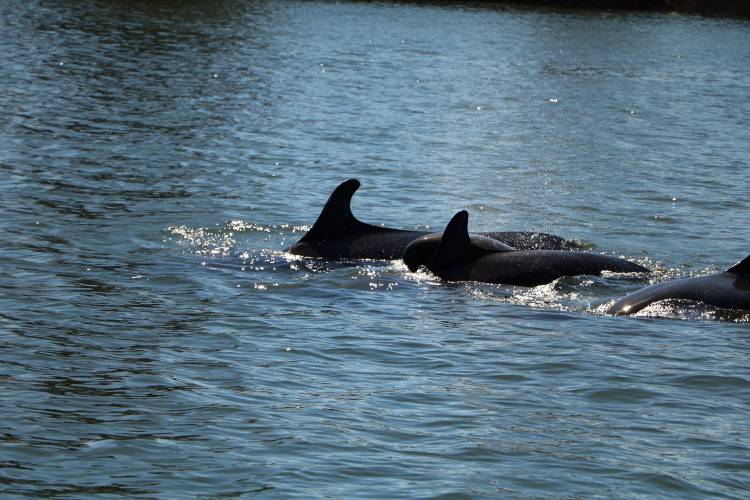
Yesterday morning, 5 February, it was decided that action needed to be taken to shepherd the false killer whales out of the harbour. They appeared healthy, but there was concern that they would be unable to navigate out of the harbour due to the noise (dolphins rely on echolocation to navigate) and that they would starve.
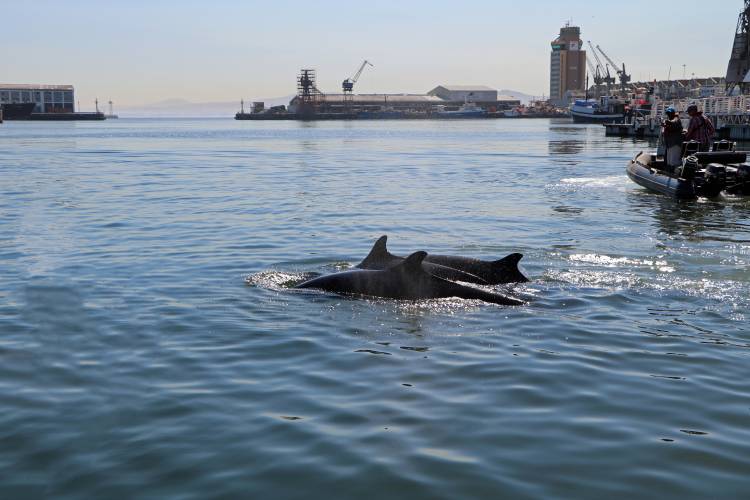
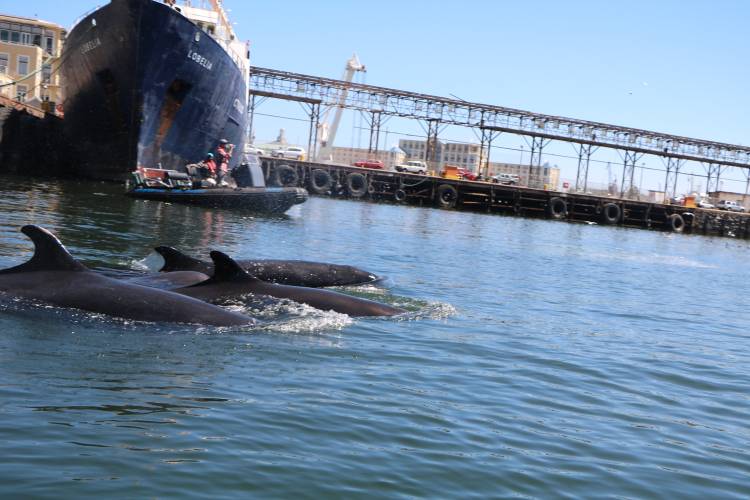
Three boats were dispatched, staffed by the Aquarium, DEA and CoCT, to carry out manoeuvres to drive the false killer whales from the inner harbour, the V&A Waterfront's Alfred Basin, either out of the harbour completely or into an area with less boat activity.
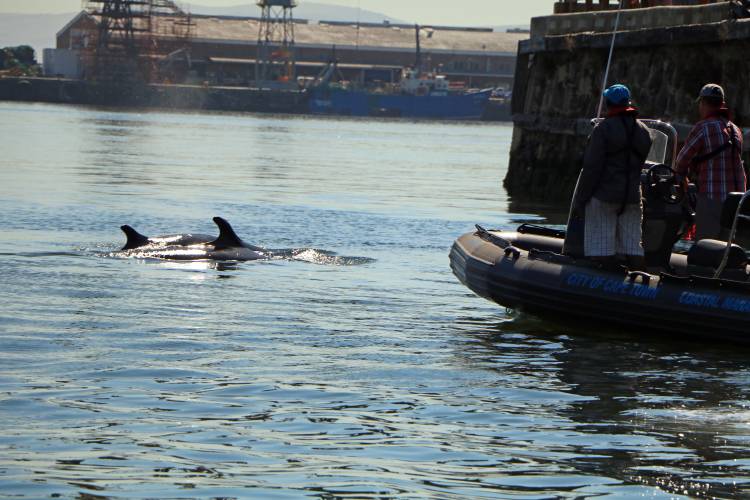
A secondary goal was to get close enough to the animals to assess their health and collect DNA to contribute to global tracking efforts.
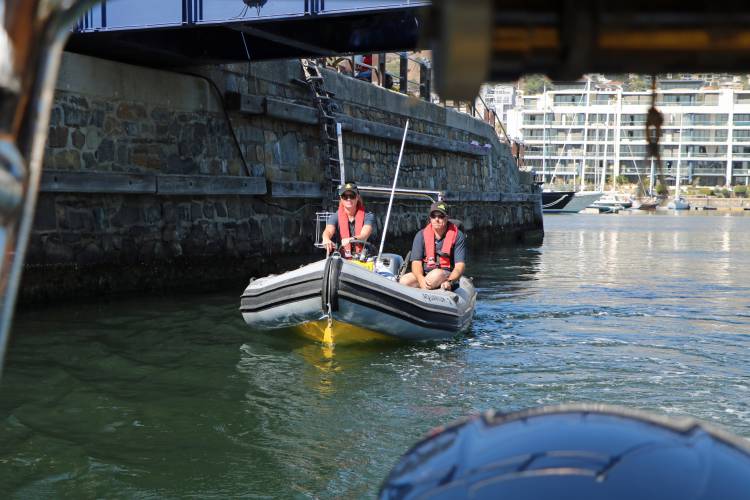
Together, the loud engines of the boats were used to shepherd the false killer whales into the Victoria Basin, no small task as we needed to be careful to avoid boat strikes - either knocking them with our own boats or driving them in front of other ship traffic.
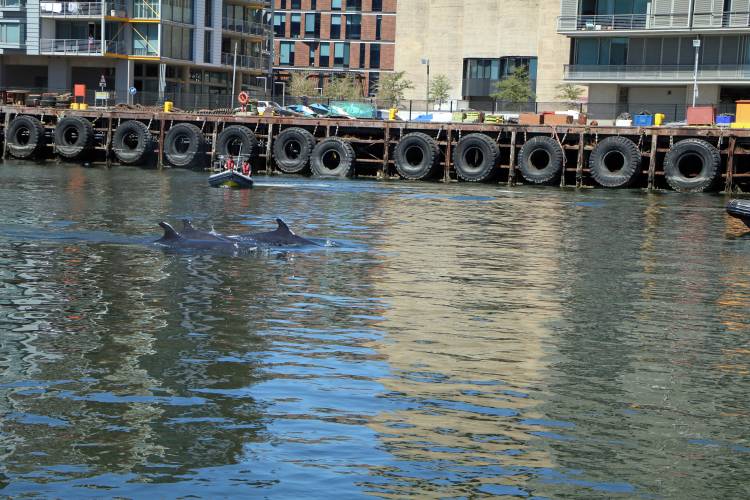
Eventually, the pod was coralled to the harbour mouth, but at this stage it seemed unwilling to venture back into Table Bay.
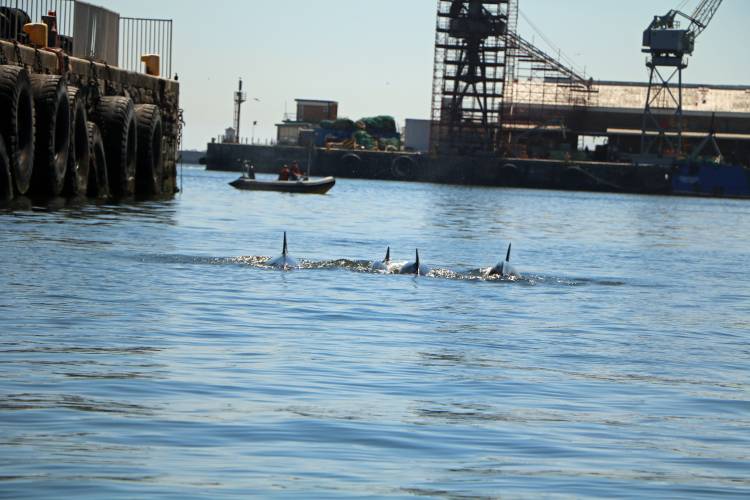
It was decided that the false killer whales were growing used to the sounds of our boat engines, and had learned that they could dive under them instead of swimming away. Instead of continuing to attempt to drive them out of the harbour, we shepherded them into the much quieter South Arm of the harbour.
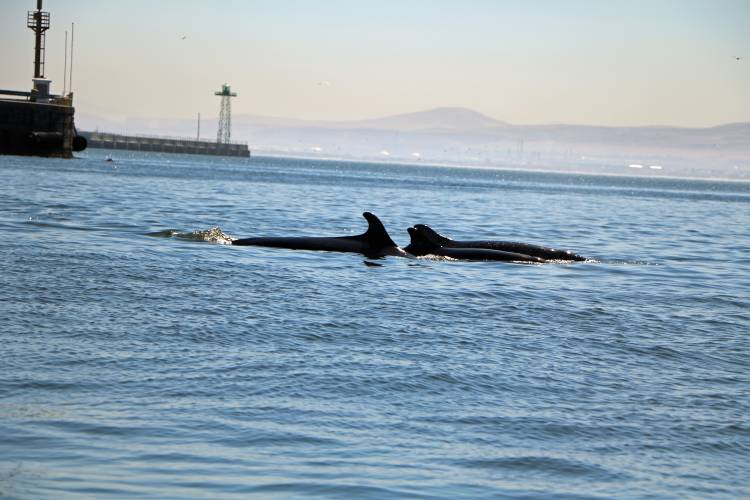
It is hoped that from here, they will make a direct exit from the harbour when it is quieter. We will continue to monitor the area and provide ongoing updates.
What should you do if you find one?
If you come across a beached false killer whale (or any kind of whale or dolphin for that matter), we strongly urge you to follow the advice of the Department of Environmental Affairs:
The public are urged not to refloat this species as the injured one may attract healthy individuals to shallow waters and lead to a mass stranding.
Instead, you should contact one of the following organisations to dispatch an appropriate response:
- Two Oceans Aquarium - 021 418 3823
- DEA - 083 462 5345
- City of Cape Town - 083 940 8143
- NSRI - 082 380 3800
What is a false killer whale?
False killer whales (Pseudorca crassidens) are a rare dolphin species, widely distributed in tropical and subtropical deep oceans. They seldom enter shallow coastal waters, and their ongoing presence in the waters of Cape Town is quite unusual (although not unprecedented).
Their bodies are slender and they are usually a dark grey or black, giving them the name "blackfish" in some countries. Sometimes they have pale grey or white markings on the sides of their faces and on their chests. They do not have beaks like bottlenose dolphins, the species that most people associate with "dolphins", but their upper jaws form smooth domes, known as "melons".
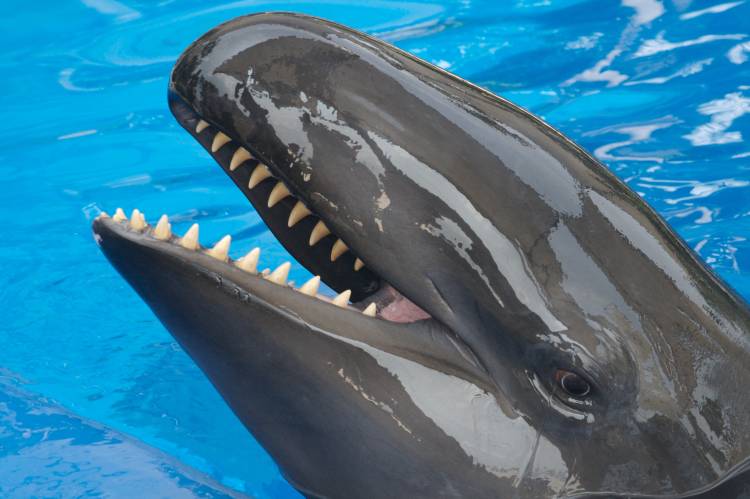
They are the fourth largest species of dolphin, and although they look similar to the more famous orca (killer whale), they are not closely related. False killer whales can grow up to six metres long and weigh over two tons. They have been known to live over 65 years.
False killer whales are carnivores and readily eat a wide variety of prey including fish, squid, other dolphins, sperm whales and seals. They use their intelligence to their advantage and are known to plunder fish traps and longlines.
They are highly social animals, typically forming pods of 10 to 60 members, but often more. They will often associate with other species of dolphin, particularly bottlenose dolphins with which they can hybridise (the hybrid dolphin is called a "wholphin").
Are they at risk? Why are they beaching?
False killer whales are known to be susceptible to mass strandings - in one case over 800 became stranded. The exact reasons for these beachings are unknown, but current science suggests that it is due to loud, man-made noises disrupting the echolocation sense that they use to navigate.
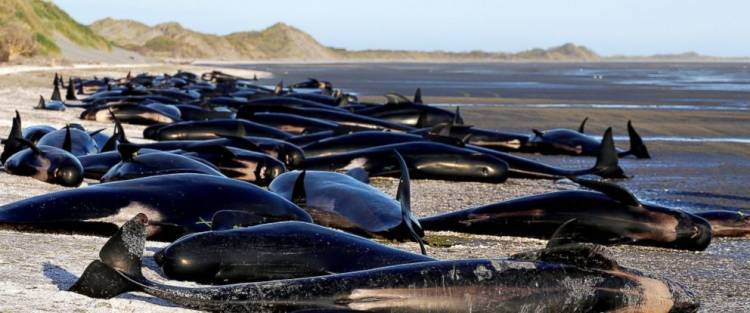
Like most sea life, their greatest threat is humans. Entanglement in nets and fishing lines can result in them drowning. Overfishing in their natural hunting grounds can lead to starvation - they need to consume approx. 5% of their body weight a day.
The IUCN lists false killer whales as "Data Deficient" - due to their rarity, it is difficult to assess their exact numbers. However, we must assume that they are facing severe threats.
More news about the false killer whales:
@environmentza on Stranded false killer #WHALES @VandAWaterfront: This group was stranded in @BloubergBC and was re-floated by public. One of adults has head injuries, while the other two look in perfect condition. More here » https://t.co/aKmJBDIhz2 pic.twitter.com/80SmZZJ4br
— Environmentza (@environmentza) February 6, 2018
Seems our pod of #FalseKillerwhales loves the @VandAWaterfront almost as much as we do. �� The DEA, @CityofCT & @2OceansAquarium teams have managed to get them out of traffic but they remain at the south arm of the harbour. Teams have opted not to stress them further for the day. pic.twitter.com/BW70vVuuGw
— Environmentza (@environmentza) February 5, 2018
#falsekillerwhale spotted in the @VandAWaterfront whilst on @AWOLTours #cape town #city #cycletour. Two oceans aquarium staff are keeping an eye on the pod and suspect one has a head injury and they taking refuge in the waterfront whilst it's wounds heal pic.twitter.com/0lXKDvRxqZ
— AWOL Tours (@AWOLTours) February 5, 2018
And a video to see their efforts. ❤ pic.twitter.com/1O4IQ0lItO
— Leanne Kruger (@krugerleanne) February 4, 2018
#FalseKillerWhale update: The DEA is aware of another whale that stranded & died at Koeberg. This one was also injured. The public attempted to refloat on Sunday and she restranded this morning. pic.twitter.com/1V0V7NrQql
— Environmentza (@environmentza) February 5, 2018
#FunFact A false killer whale and a bottlenose dolphin mated in captivity and produced a fertile calf. The hybrid offspring has been called a “wholphin”.
— Escape 2 Africa (@Escape_2_Africa) February 5, 2018
False killer whales surface at V&A Waterfront | CapeTown ETC https://t.co/bsWRelIXyL via @capetownetc
Some photos of the beaching yesterday. Well done to the members of the public who saved them. pic.twitter.com/xYlZCgJRIO
— Leanne Kruger (@krugerleanne) February 4, 2018
This led DEA to suspect that the injured whale may be responsible for the beaching yesterday. The current location is the best under the circumstances. The department hopes that the injured whale will rest and gather enough strength to go back offshore lest they re-strand.
— Environmentza (@environmentza) February 4, 2018
ALERT: 4 False killer whales, including a calf are currently swimming around boats at the @VandAWaterfront . 3 stranded whales were rescued from Blouberg yday. The DEA, @2OceansAquarium ,@NSRI and @CityofCT are monitoring them. Skippers encouraged not to stop near them for pics. pic.twitter.com/6B2LoBB7cR
— Environmentza (@environmentza) February 4, 2018
_450_310_70_s_c1_c_t.jpg)

_450_310_70_s_c1_c_t.jpg)