Anyone who’s visited the V&A Waterfront or taken a boat trip around the marina, would’ve noticed the Cape fur seals that frolic in the water. However not many people are aware that these adorable mammals are facing serious danger every day, even if their immediate environment appears innocuous.
This danger is pollution. The seals spotted around the waterfront are often entangled in strapping bands used for packaging. These bands cause deep wounds, strangulation and ultimately, death.
For some time, Assistant Curator Claire Taylor and Assistant Technical Manager Vincent Calder have been working on various methods to deal with these injured seals, the sight of which has distressed Aquarium staff and members of the public (let alone the distress caused to the animals themselves).
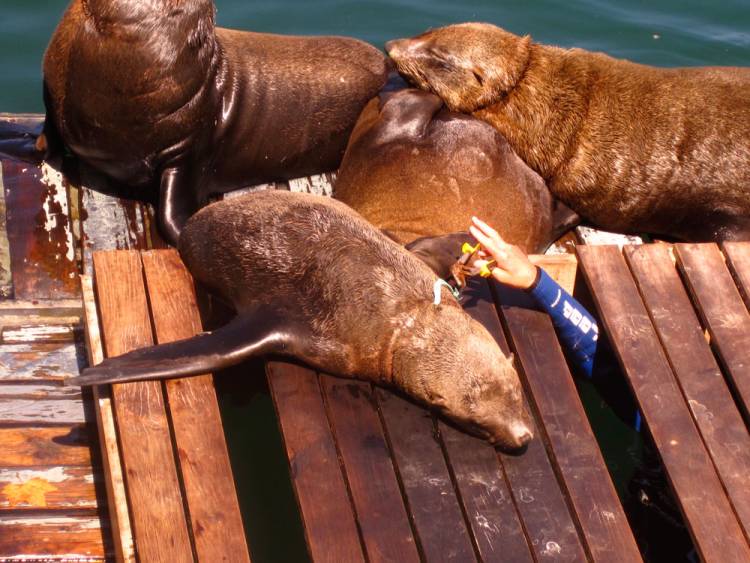
They are also working closely with Mike Meyer of Marine and Coastal Management (MCM) to remove nooses from affected seals and tag the animals.
Depending on the extent of the injury, it is sometimes necessary to restrain the seals to remove the bands and treat them, which is easier said than done!
That’s why Meyer, Taylor and Calder are pinning their hopes on a platform being built right outside the Aquarium, to “gate” injured seals while quickly and effectively tending to their injuries.
To raise funds for this project, the Aquarium, in association with our partner SAPPI, is hosting a special, intimate concert by Peter Sarstedt on 30 September. Buy your ticket now and help us help our seals … And enjoy a wonderful evening of music to boot!
Sadly, pollution is not the Cape fur seal’s only adversary. According to Biodiversity Explorer, “Uncontrolled exploitation of the Cape fur seal led to a serious reduction in population numbers. In 1893 they were protected by an Act of the Cape Parliament and harvesting was controlled until 1990 when it was finally prohibited. The protection of the seals and the halt of all ‘sealing’ activities resulted in the recovery of the populations.”
But seals are not always popular with the fishing industry. “Fishermen maintain that seals seriously reduce local fish populations and consequently (reduce) their catches,” says Biodiversity Explorer.
Not only that, but seals’ natural diet – mostly shoaling fish species – is threatened because of excessive commercial fishing, making seals’ rightful place in the oceans precarious to say the least.
Breeding season starts in October, and once the pregnant cows give birth to a single black pup (after an eight-month gestation period), they will nurse their offspring for a year. This is a particularly vulnerable time for mother and baby, making the need to for a safe environment all the more immediate.