Two Oceans Aquarium Communications and Sustainability Manager Helen Lockhart responds to a troubling alert from a member of the public regarding the killing of small sharks on the South African coast.
I’ve just received a call from a concerned citizen who wanted to know whether there are venomous sharks in South African waters. According to the caller, her husband was taken out on a deep-sea fishing trip off East London and during the trip they caught a fair number of small sharks. The skipper told the anglers to “club the sharks to death” before throwing them overboard because they apparently have “venomous fins”.
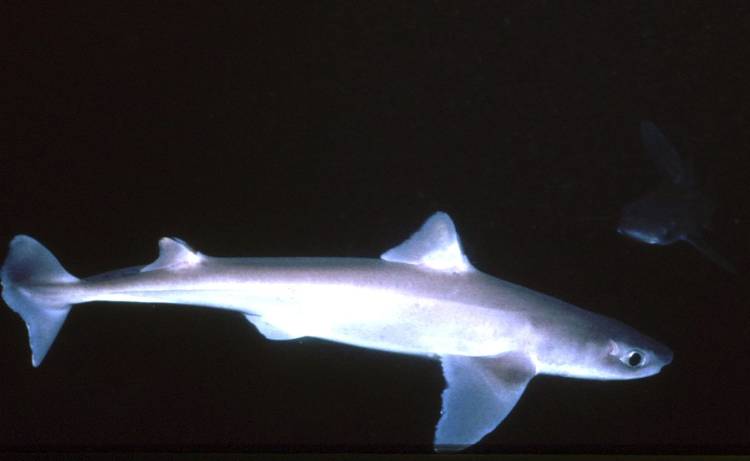
Well, this caught me off guard because, firstly, I had never heard of venomous sharks and, secondly, I was alarmed that people were being instructed to “club them to death”. So I chatted to a couple of our aquarists and was told that the sharks were probably shortnose spiny dogfish (Squalus megalops). These sharks are abundant in our waters and, according to one of the aquarists, are regularly caught off Arniston as well as other popular angling spots. Like me, the aquarists were shocked to hear that these animals were being killed because of misleading information.
Shortnose spiny dogfish have two dorsal fins with a spine in front of each fin. The fins are not venomous and nor are the spines. The spines will inflict a nasty wound if they pierce the skin, but are unlikely to cause fatal injury.
These sharks are slow-growing: females reach sexual maturity at about 15 years and can live up to 32 years, while males mature at about nine years with a lifespan of about 29 years. They are ovoviviparous (the embryo hatches from the egg inside the uterus where it feeds off its own yolk sac until it is born) and produce two to four pups per litter after a gestation period of up to 20 months.
They live at depths of up to 500m and feed mainly on small fish, crustaceans, cephalopods and worms. They grow to about 78cm in length.
I checked my facts with Professor Malcolm Smale at the Bayworld Centre for Research and Education. He made the following comments:
“I have looked up Bruce Halstead’s old but, I think, reliable reference (Halstead BW (1980) Dangerous Marine Animals that Bite, Sting, Shock are Non-Edible. Cornell Maritime Press Centreville, Maryland). He talks about Squalus acanthias (a related species that has white spots and apparently has a small population off the Western Cape on the Atlantic coast and more common to northern hemisphere waters). This species, he says, does have a poison gland on the spine. He states that the venom gland appears to be located adjacent to the anterior margin of each of the two dorsal fins. He states that the venom gland appears as a glistening, whitish substance situated in a shallow groove on the back of the upper portion of each spine. When the spine enters the skin, the venom gland is damaged and the venom enters the flesh of the victim.
“Despite that, I am not personally aware of any serious sting that has led to any significant injury from these sharks. It is possible that any adverse effects would be related to anaphylactic shock due to the introduction to a protein to which the victim is allergic.
“Treatment is the normal hot water treatment to break down the protein (but beware of scalding). Medical follow-up is highly recommended in the event of any adverse reactions.
“As far as beating the shark to death – that may be a slight overreaction. The use of gloves and immobilising the small shark under a cloth may be sufficient to remove the hook and release the shark. This is easier with two people (one controlling the shark and the other removing the hook).
“I imagine the same precautions are adequate with regards to shortnose spiny dogfish.”
Sharks are among the most maligned creatures on the planet thanks to movies like Jaws, and unfortunately many people still hold the perception that the only good shark is a dead shark. In fact more than 100-million sharks are killed annually around the world. However, many shark species are harmless and the only danger is human ignorance.
I applaud the woman who called in to express her concern. She has committed to following up with the deep-sea fishing company and to put the owner in touch with us at the Aquarium so that we can provide the correct information and hopefully prevent further unnecessary shark deaths in the future.
Hopefully the information in this blog will also reach other anglers who might not have known the facts about these two interesting shark species.
Stay in touch: For daily Aquarium updates, follow us on Twitter (@2OceansAquarium) and become a fan on Facebook.