Some of you may have seen the recent comment by Dr Antje Steinfurth regarding the species of penguin which features on our beautiful Ocean Promise bags. Antje, who is currently a Postdoctoral Fellow with the Animal Demography Unit at the University of Cape Town, humbly alerted us to the fact that the penguin image on the bag is not that of an African penguin, but actually a Humboldt penguin!
Antje has spent many years working with penguins, including the African, the Humboldt, the Galápagos and Magellanic species, and she clearly has a well-trained eye in order to spot the differences between these very similar species.
In the case of the African and Humboldt penguins, the most distinguishing feature between the two species is the bill. Humboldts have slightly bigger bills with fewer feathers around them, thus exposing a much larger area of bare skin around the bill than do African penguins. Although I tried hard to see the difference, it was only when Antje sent me these pictures that I could see the obvious!
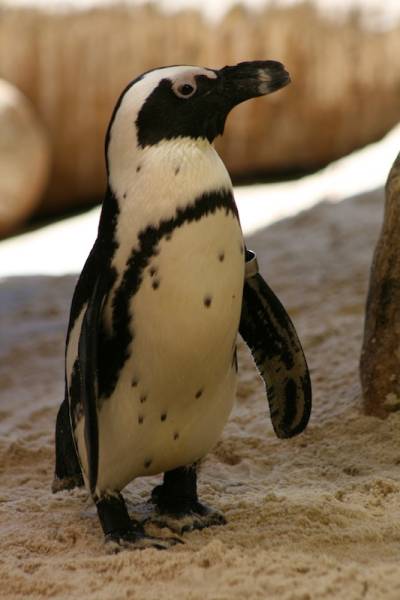
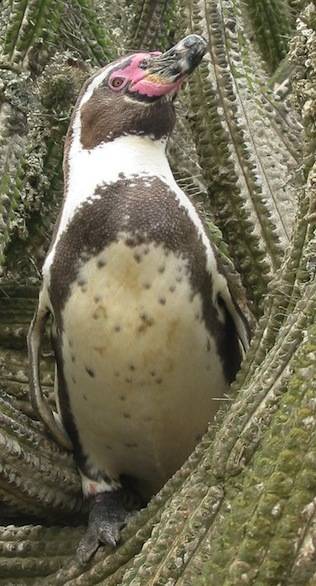
Whereas African penguins are found off southern Africa, Humboldt penguins live off South America, along the coasts of Peru and Chile. Their name originates from the Humboldt Current (named after the German naturalist Friedrich Humboldt), which runs from the Antarctic to the equator along the west coast of South America.
Like our friends, the African penguins, Humboldts are also under threat as a result of overfishing, pollution, guano collecting and climate change. The latest population estimate is that there are only between 30,000 and 40,000 breeding pairs left in the world (De la Puente, S., Bussalleu, A., Cardeña, M., Valdés-Velásquez, A., Majluf, P. and Simeone, A. 2013. Humboldt penguins. In Penguins: Natural History and Conservation. García Borboroglu, P. and Boersma P.D. eds. UW Press, Seattle U.S.A. eds. 336 pp. University of Washington Press, Sea). As a result of severe population fluctuations, Humboldts are currently classified as Vulnerable on the International Union for Conservation of Nature (IUCN) Red List, which means that they are in great danger of becoming extinct in the wild.
In fact, 60 percent of all penguin species are listed as threatened, vulnerable or endangered by the IUCN.
So, while the penguin on the bag is incorrect, we’ve decided to see the error in a positive light and think of it as “penguins helping penguins”. As Antje said: “In the end, it is ONE OCEAN, isn’t it? And the protection and preservation of penguins (and biodiversity in general) shouldn’t stop on our doorstep …”
ALL penguins, no matter where they are in the world, will be grateful to you for taking the Ocean Promise: “Whatever I do, wherever I am, I promise to help conserve the life that depends on healthy oceans.”
Indeed, the future of ALL penguins depends on you keeping your promise to recycle and to reduce the use of plastic and to purchase only sustainable seafood (www.wwfsassi.co.za).
If you would like to know more about penguins, please visit: http://www.globalpenguinsociety.org/
Stay in touch: for daily Aquarium updates, follow us on Twitter (@2OceansAquarium) and become a fan on Facebook.