We recently hosted another SeaFans course, aimed at Grade 9 students. On Monday 7 July, Bianca Engel, Deputy Head of Education, welcomed 29 nervous students from various schools in Cape Town. One learner even came all the way from Hopefield High School, which is close to Saldanha in the Western Cape.
Our SeaFans course is designed to spike the interest of high school learners in marine sciences, both the oceanographical and zoological aspects of it. Oceanography deals with the physical aspects of the oceans, such as salinity and density of seawater, whereas the zoological side is all about the animals and ecosystems that exist in the marine world. Grade 9 is an important time in a teenager’s life, as the ninth year means decision time – what subjects to choose for the right career after school.
All of our courses start with a pre-test, which we use to ascertain the knowledge level of the children before they start our courses. The average percentage for this pre-test for our SeaFans course was 37%.
After the test and a short ice-breaker, Bianca launched into the physical characteristics of the oceans, such as temperature, salinity and density, and how all of these affect animal and plant life. Ocean currents were also introduced, especially the two around the South African coast: the Benguela and Agulhas currents.
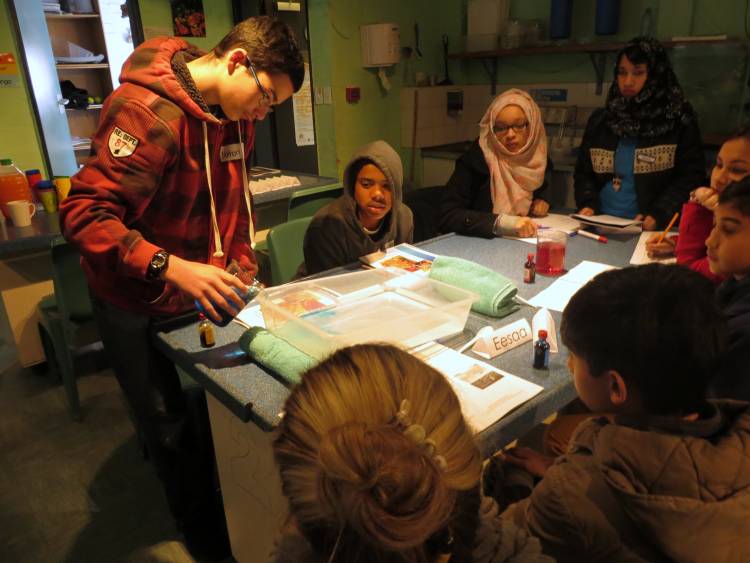
The children did an experiment on how water sinks or rises according to temperature. They received a beaker with extremely cold water and another with very hot water. A blue food dye was added to the cold water and a red one to the hot water. Both waters were then added to a big container to see which water temperature would settle on the bottom and which would form as a top layer. What do you think happened? Did the cold water settle on the top or bottom? A similar experiment was then conducted on salinity, to see how freshwater, salty and very salty water would layer itself when added to one container.
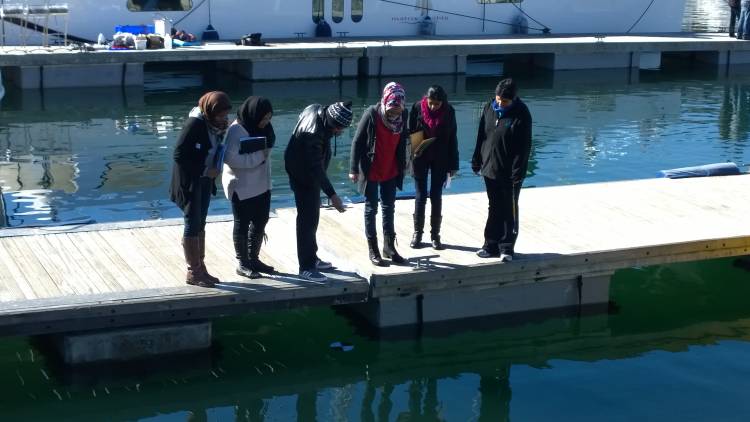
Another characteristic of water that can be measured is clarity. For this the SeaFans went outside to the harbour next door to the Aquarium armed with a Secchi disc. A Secchi disc is a simple, opaque white disc attached to some rope or string. The disc is lowered into the water until it cannot be seen anymore. This is known as the Secchi depth, i.e. the maximum clarity level of the water.
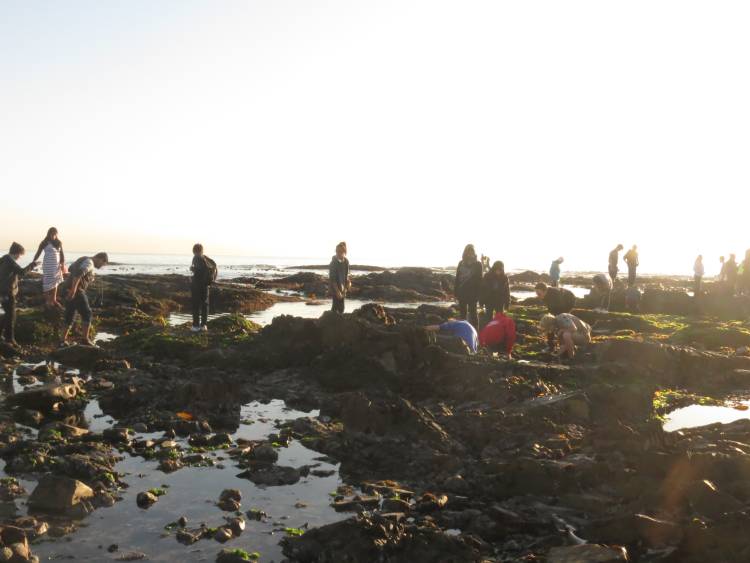
Another outdoor activity that is part of the programme is a rocky shore exploration. This gives the children the opportunity to find some of the invertebrates and plants they have been introduced to in the classroom. Above, the SeaFans are seen exploring the rocky shores of Mouille Point.
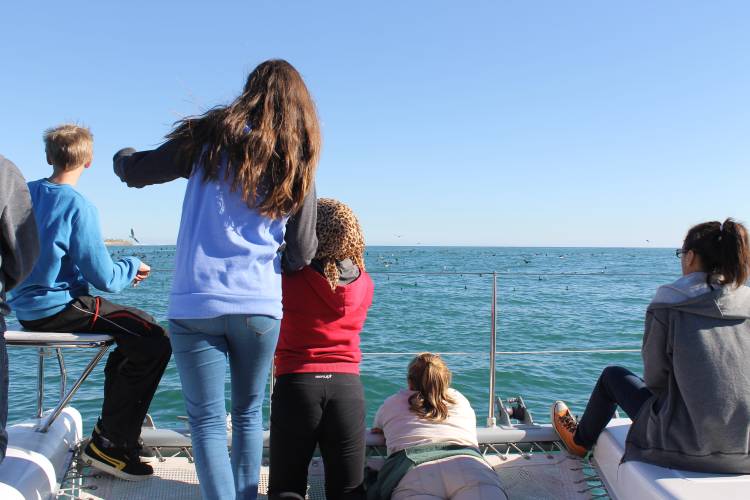
A favourite activity is a boat trip on the Ocean Adventurer. Common sightings include Heaviside dolphins (an endemic species only found on the West Coast of Southern Africa) and seals, as well as African penguins and various other marine birds. If you are lucky, it is the time of the year to spot a whale or two as well.
The course was a great success, with all 29 children “graduating” from the course with flying colours and a certificate to prove it. We gave them the same test as in the beginning of the course and the group scored an average of 86%! Clearly they learned something during the week, which is what we aim for with all our courses.
Our next course this year is our famous Young Biologist course for Grade 10s. Find out more about the course here and apply for it here.
Stay in touch: for daily Aquarium updates, follow us on Twitter (@2OceansAquarium) and become a fan on Facebook.