
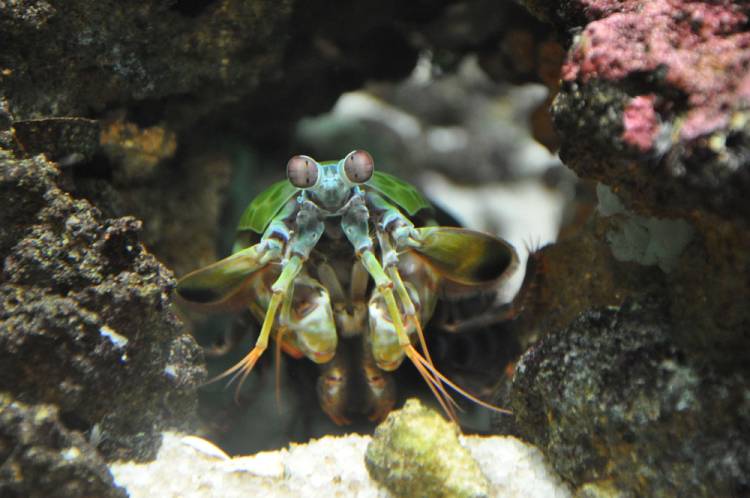
Peacock mantis shrimps, much like their name suggests, present themselves in a blur of colour. Males are bright green with detailed crimson and blue appendages while females are a more downplayed olive green or brown, looking more like the praying mantis. However, looks can be deceiving. These highly impressive ocean creatures are lethal, given their unique and highly destructive hunting methods.
These praying mantis lookalikes can generally be divided into “smashers” and “spearers”, which can be differentiated by their varying front limbs or “raptorial appendages”.
“Smashers” use their solid, blunt forelimbs to forcefully crack the stubborn shells of their prey, typically crabs or molluscs. They have a strike so powerful it is likened to the force generated by a .22 caliber gun, with larger “smashers” having been known to crack thick aquarium glass in a single dramatic strike.
“Spearers”, who prefer softer prey such as fish, are endowed with barbed appendages ideal for stabbing, slicing and snagging prey and have been labelled “thumb slicers” by many divers who regrettably come into contact with these powerful creatures. They are known as ambush predators, cunningly burrowing into the sand where they wait for intruders and unsuspecting prey to pass.
Both types strike forcibly and rapidly, at speeds between 14 and 23m per second, with peak accelerations ranging from 6 300 to 8 000 times that of gravity, and are able to inflict serious harm on creatures significantly larger than them.
The striped or zebra mantis shrimp is the world’s largest mantis shrimp and can grow up to 40cm long (compared to the peacock mantis shrimp which only reaches up to 18cm). Like the peacock mantis shrimp, this striped creature uses two spear-like appendages to capture prey.
Video courtesy RoyL Caldwell