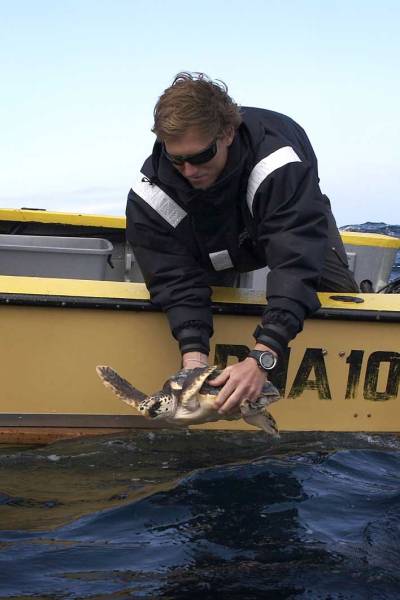
One was found near Kalk Bay and the second one, which sadly did not survive, at Fish Hoek.
The Aquarium has been rehabilitating and releasing turtles for several years, and this programme has attracted the attention of third-year University of Cape Town student Talitha Noble.
Noble, who is currently completing a BSc in Marine Biology and Applied Biology, is an Aquarium volunteer and attended the Young Biologist course as a Grade 10 student in 2007. She says: “Turtles are my particular interest and passion. I hope to be able to further this interest academically, both in research and conservation.”
Noble is particularly interested in studying the turtle recovery process at the Aquarium, and building an accurate recovery growth curve. She is also interested in growing the data, which will entail looking at inter alia stranding trends, including identifying the main beaches where the turtles are stranded, the months in which strandings predominantly occur, and the wind conditions prior to strandings.
She is also keen to measure activity versus rest periods during the recovery process at the Aquarium: her assumption is that there is a correlation between activity and health. In the long term she hopes to use the accumulated data to create an integrated biological model (IBM), which will help to provide greater insight into the lives of the stranded turtles. Although her research is currently not part of her university work, Noble says: “The work I’m doing with the turtles now is a combination of building experience and doing something useful with the six years of data which the Aquarium has. I do, however, hope that this is a project I can continue doing at an Honours level and possibly further.”
As the winter months approach, the incidence of turtle strandings increases and the Aquarium is on standby to accept these animals and rehabilitate them in preparation for their release back into the ocean. The turtles are swept down from the northern coast of KwaZulu-Natal (where they hatch) in the mighty Agulhas current, and washed ashore by stormy seas. They are often in a weak condition, having been exposed to cold water and suffering from dehydration. This is an annual occurrence and so the Aquarium is accustomed to receiving the juveniles.
“We urge people to bring the turtles to the Aquarium, where we will rehabilitate them and once they are strong enough, we will release them back into the Indian Ocean,” says Helen Lockhart, communications and sustainability manager for the Aquarium.
What to do when you find a washed-up turtle:
- Place the turtle in suitably large container that allows the turtle to breathe freely.
- At no stage should the turtle be placed in water, as it could drown.
- Keep the turtle at room temperature and out of the sun.
- Take note of where and when the turtle was found.
- Contact the Two Oceans Aquarium on (021) 418 3823.
- Bring the turtle to the Aquarium as soon as possible.
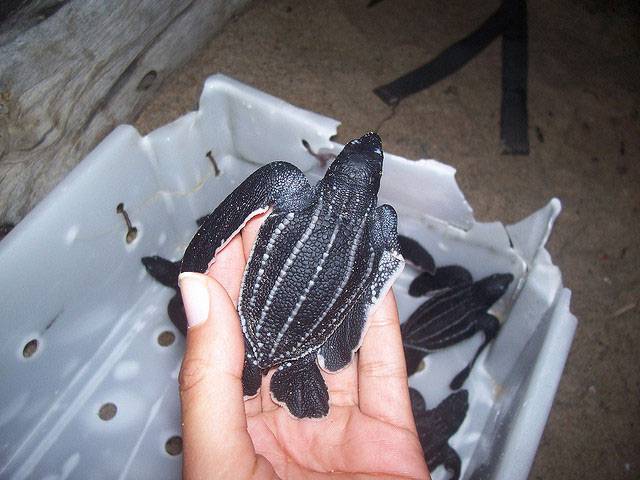
Sea turtles are living dinosaurs, having survived some 90-million years since the Age of the Reptiles, yet today they are threatened with extinction. Human threats to turtles include umbrellas, deckchairs and 4x4 vehicles on beaches, which damage potential nesting sites and even destroy existing nests; poaching (eggs are stolen from nests for food); plastic (turtles mistake plastic bags for food, and die); and long-line fishing and gill nets, which kill hundreds of turtles every year.
Kevin Spiby, the aquarist who runs the turtle rehabilitation programme at the Aquarium, says: “It is really important that we try to rehabilitate every stranded sea turtle. Each turtle that we can return to health, and the sea, is another individual that can contribute to the survival of the species.”
Stay in touch: for daily Aquarium updates, follow us on Twitter (@2OceansAquarium) and become a fan on Facebook.