Here at Cape Town’s Two Oceans Aquarium, we don’t only exhibit fish … We’ve also got frogs, snakes, shongololos, reptiles and birds. Yes, birds! We’re particularly fond of our African black oystercatcher in the Sappi River Meander. As part of our series of deep-sea creatures in the wild, here are two other kinds of oystercatcher: the blackish oystercatcher and the magellanic oystercatcher.
These images were taken by South African birdwatcher Werner Sinclair, who ventured to the Antarctic via Tierra del Fuego (the southernmost tip of South America). We’ve shown you his eye-opening images of king penguins at Salisbury Plain; now take a look at our oystercatcher’s Antarctic cousins, snapped in Tierra del Fuego National Park and on New Island in the Falklands.
But first, let’s say hello to our own oystercatcher.
African black oystercatcher
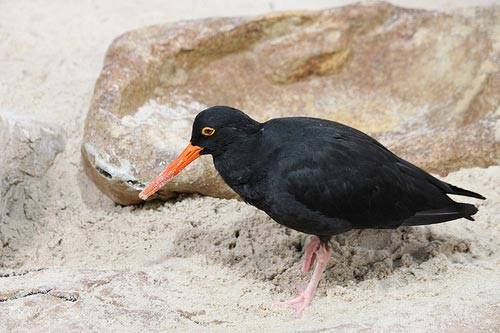
The African black oystercatcher (Haematopus moquini) “has glossy black plumage, which contrasts with its red eye, and bright orangey-red eye-ring and long bill. The sturdy legs are a deep pinkish-red,” according to ARKive.com. The same website tells us that the African black oystercatcher breeds along the Southern African coast from northern Namibia to the Eastern Cape.
According to BirdLife International, “the population is estimated at 5 000 to 6 000 individuals.” Our African black oystercatcher hatched here in 2003 and, as far as we know, this is the first time this species has successfully bred in captivity.
Blackish oystercatcher
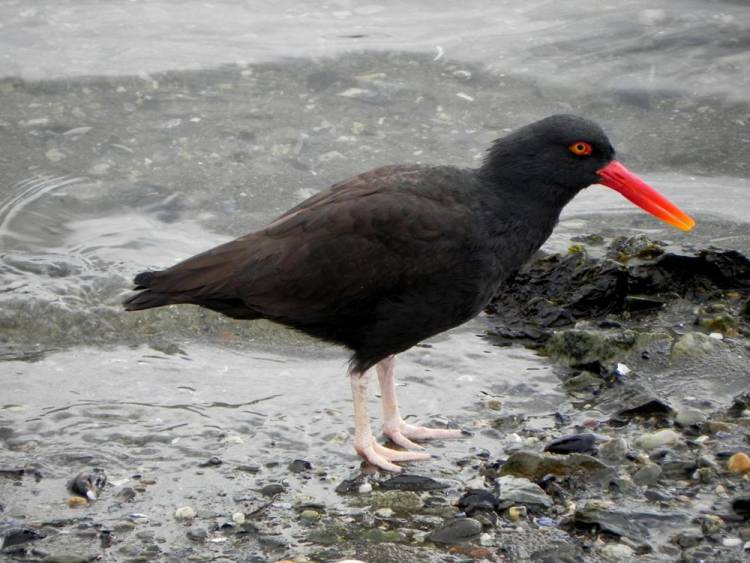
This blackish oystercatcher (Haematopus ater) was seen at Tierra del Fuego National Park in Argentina. Its sharp beak is brighter red and shorter than that of the African black oystercatcher, and its eye-ring is red, as opposed to the African black oystercatcher’s orange eye-ring. Its plumage is dark brown and its legs are white.
Magellanic oystercatcher
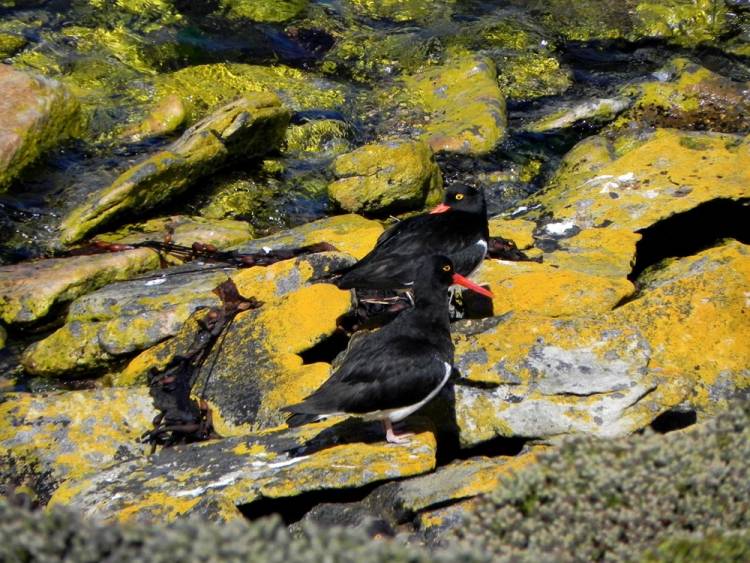
These magellanic oystercatchers (Haematopus leucopodus) were seen on New Island, one of the Falkland Islands. This species has a white belly, a yellow eye and eye-ring, and pink legs. Oystercatchers are wading birds, and use their long, dagger-like beaks for prying open molluscs.