Welcome to part two of our four-part snake blog, celebrating these fascinating reptiles ahead of their arrival at the Aquarium with local snake handler Francois van Zyl. As part of our exciting school holiday and Easter entertainment lineup, Francois will bring a number of snake species to the Aquarium, including a snouted cobra, egg eater and mole snake, for a series of interactive and fun presentations.
The snake demonstration gets underway with two shows per day at 10h30 and 13h00 from 2 to 10 April and then again from 22 to 27 April.
See also: Creepy Crawlies! Puff adders, rattlesnakes and Cape cobras coming this way
Egg eater (Dasypeltis)
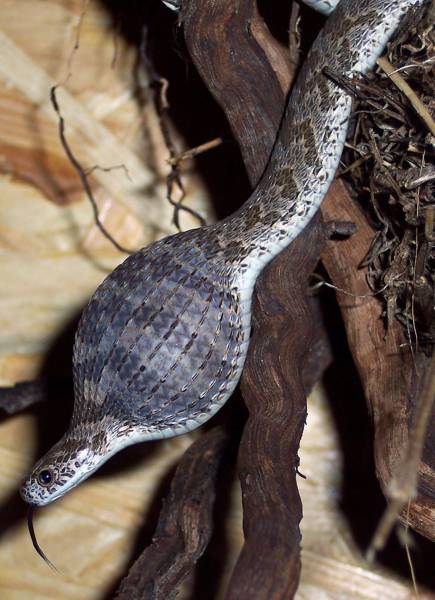
Watching this little guy feed is a fascinating, if not comical, sight. As the name suggests, the egg eater snake feeds exclusively on eggs, which are often four times larger than their own heads. They are able to cope with this demanding task because of the highly elastic skin in their throats, as well as the elastic ligament connecting their lower jaws, which are not fused together as is the case with other animals.
As Graham Alexander and Johan Marais point out in A Guide to the Reptiles of Southern Africa (2007), a common misconception is that snakes dislocate their jaws to feed – but this would make them incapable of doing so.
Rather, they “walk” their jaws over prey, using their teeth to assist in the process. But the toothless egg eater has to push its jaws over the smooth egg, and it is believed that they excrete lubrication from glands behind the eyes to help with this. The snake cracks the egg in its throat, swallows the contents and spits out the shell in a neat boat shape.
Egg eaters are widely distributed across Southern Africa, and regularly shelter in termite mounds or under rocks in grassland terrain. When threatened, they adopt a surprised, gaping jaw posture as part of their defence mechanism, as if someone had just told them they would only have access to ostrich eggs for the rest of their days.
Egg eaters also rub their rough dorsal scales together to create a sound that mimics the hissing of more dangerous snake species. This, together with the vivid markings of some egg eaters, can often land them in trouble with humans.
“Because egg eaters are mistaken for small poisonous adders, they are often needlessly killed,” explains Francois. “They can grow to be about a metre in length.” Females lay clutches of between six to 28 eggs, and hatchlings are usually between 200 and 280mm in length.
Mole snake (Pseudaspis cana)
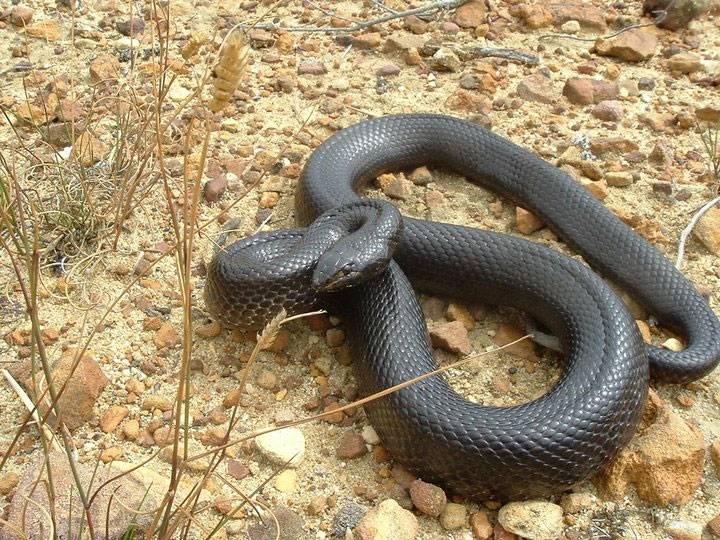
Looking at its behavioural patterns and aggressive demeanour, it’s safe to say that the mole snake is definitely the brawler of the snake kingdom. Although non-toxic and ultimately harmless to humans, this powerful constrictor can deliver a nasty bite where the resulting wound may require stitches.
“They have six rows of huge teeth – four at the top of the mouth and two at the bottom, and a bite can be quite painful,” says Francois.
Male mole snakes also duke it out when competing for a female. They bite each other viciously, usually concentrating on the neck and tail, while a bite to the body often exposes ribs. But, remarkably, as explained in A Guide to the Reptiles of Southern Africa, the snakes often appear to recover from these grievous wounds.
Mating occurs in November, and the young grow within the female until they are able to survive on their own outside her body (viviparous). Typically, 25 to 50 young are born in late summer, but as many as 95 young have been produced by a single female.
The mole snake is found throughout most of Southern Africa, but particularly where they have access to their favourite food source, the mole rat. These snakes also vary in colour depending on their location.
For example, mole snakes from the Cape are much darker compared to the other variations of brown, orange and beige specimens found in different parts of the country.
Snouted cobra (Naja annulifera)
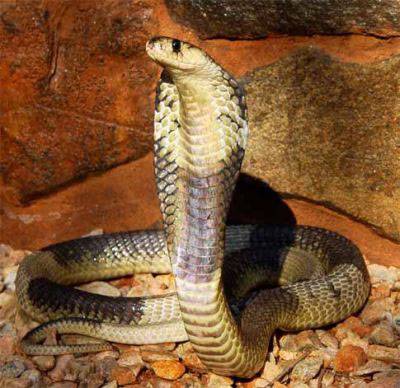
This is the type of cobra one would typically see rising spellbound from a snake charmer’s basket. Formerly known as a subspecies of the Egyptian cobra, Francois explains this snake is the largest of the cobras in South Africa and carries a potent neuro-toxic venom, although not as dangerous when compared to other species.
They are only found on our northern borders, near Botswana, Zimbabwe and Mozambique, and populate large regions of these countries. They prefer wooded areas along wetlands or rivers in arid savanna.
Their venom affects the nervous system and stops all nerve signals from being transmitted to the muscles in the body, which eventually leads to complete respiratory failure. Like the Cape cobra, this beautiful specimen does not spit venom.
“They come in a few colour varieties, and tend to stay in one location for long periods,” says Francois. “I will be displaying a banded variety during the demonstration.”
They bask during the morning, often spreading their impressive hoods to catch more rays, and at dusk they hunt for prey, which include amphibians, small mammals and other reptiles.
When confronted by any type of snake, especially venomous, Francois explains the best thing to do is move away as slowly as possible and not disturb it. “Keep an eye on the snake, and call someone who is capable of removing it if necessary. Always respect living creatures.”