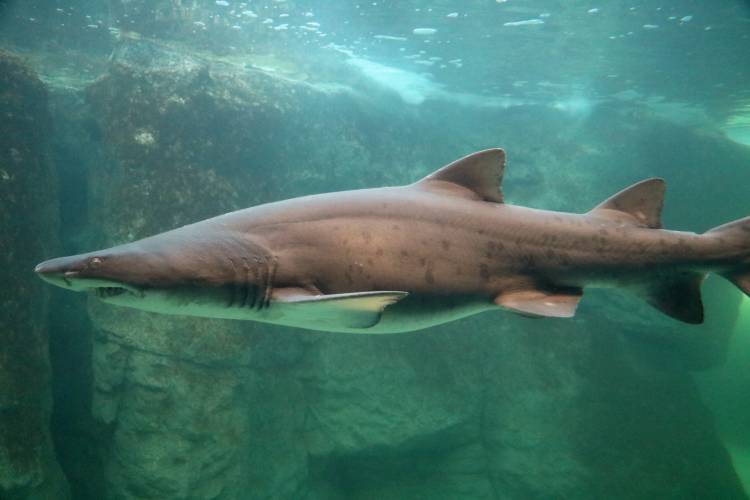

On 12 November 2018, the Two Oceans Aquarium released two ragged-tooth sharks near Struisbaai. Both of these sharks were males that had been housed in our Predator Exhibit since June 2017.
Sharks are regularly released from the Aquarium as an ongoing part of our shark tagging and tracking programme which began in 2004. Releases usually take place within a few years of the shark arriving at the Aquarium, or when the shark shows signs of reaching sexual maturity. In this case, the decision was made because Challen, the large male shark in the Predator Exhibit had begun biting one of the female sharks - a sign that he was trying to mate. This behaviour was monitored for two weeks and it was clear that she was becoming increasingly stressed. Observation is a key part of the animal husbandry process, and the continuous monitoring of our sharks' behaviour is what led to this decision.
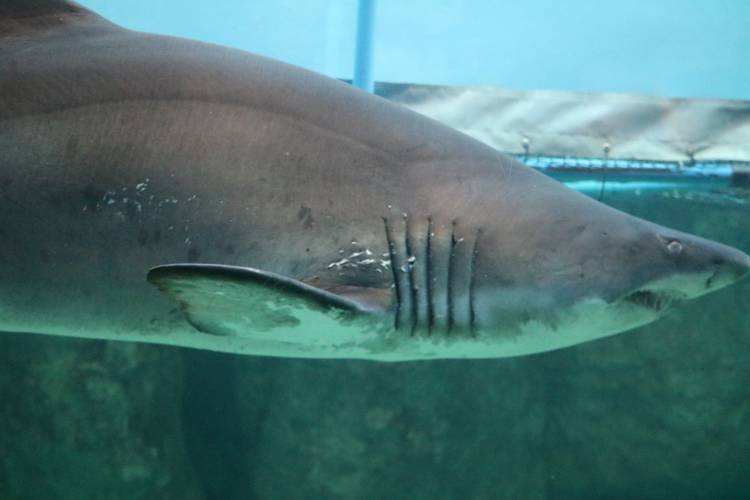
Both sharks had done well in the exhibit. Challen had grown from 170cm to 187cm and gained more than 44kg to 117kg. Bernie had shown even more growth, more than doubling in mass to 74.6kg and growing from 128cm to 162cm. Both sharks appeared healthy and excellent candidates for release.
Unfortunately, despite our experience and every precaution being taken to release these two sharks safely, Bernie, the smaller of the two released sharks was found beached a short time after release. Challen, the larger shark, has returned to the wild successfully and we are awaiting data from the tag that was embedded in him.
How are the sharks released?
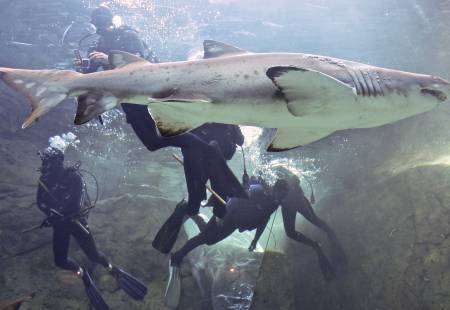
The first stage of this shark release was to move them from their exhibit into a separate quarantine pool for observation. Under the supervision of a veterinarian, the sharks are darted with a sedative that allows our team of divers and veterinary technicians to safely hoist them out of the Predator Exhibit. Once placed in a quarantine pool, the sharks were given air and a chance to recover from the sedative. During this move, the veterinarian has an opportunity to take blood samples, weigh them, examine the sharks for any abnormalities, and ensure that their behaviour and buoyancy returns to normal.
After almost two weeks under observation, a similar procedure was followed for the release phase of this exercise. Both sharks were sedated and each was hoisted into its own tank on a truck for transport to Struisbaai. Ragged-tooth sharks migrate up and down the East Coast during the course of the year, so the decision was made to make Struisbaai the release site as this is where the sharks would have the best chance of resuming their lives in the wild with other wild ragged-tooth sharks. Pure oxygen was bubbled through the water in the transport tanks and the truck stopped regularly to ensure that the sharks and water conditions were still in top shape.

Upon arrival at the release location, the sharks were given a final dose of sedative so that they could be safely moved into the ocean by the release team. The oxygen levels, sharks' breathing rate and the temperature of the transport tanks compared to the sea were all checked to ensure that conditions were ideal. The final step taken before release was for each shark to be tagged with a spaghetti tag which could be used to visually identify the sharks.
The sharks were released one at a time, with the release team wading out into the water to monitor the sharks as they recovered from the sedative. The team worked to keep the sharks upright and in shallow water until they were strong enough to swim away.

What caused the death of the shark?
Unfortunately, approximately four hours after the release, a concerned Struisbaai local notified the Aquarium team that a small ragged-tooth shark had washed up nearby and that he and a friend had tried to return it to the sea. Our team quickly went to investigate.
The shark, which we were able to identify as Bernie, the smaller of the two sharks released, was found in the nearby surf. Bernie's vital signs were very weak when he was found, and although locals were very quick in contacting Aquarium staff to attend to the shark, he could not be revived despite our team's best efforts. The team attempted to walk Bernie out into deeper seawater where they tried to revive him for over an hour in the freezing water. When that failed, Bernie was moved into one of the water tanks on our truck were he could be given pure oxygen.
The shark's body was returned to Cape Town so that a full necropsy could be done to determine the cause of death - the death of an animal is something our team takes very seriously and we carried out a thorough investigation to see how this could have been averted. Bernie's stomach was empty, and we found no signs of illness or damage to his gut, spiral valve, liver and other internal organs (although tissue samples were taken for further biopsy). No obvious cause of death could be identified from either the necropsy or from a review of the release procedure.
We speculate that this small shark was unable to properly manage its buoyancy quickly enough to avoid being pushed back to shore. Fighting the waves might have left him exhausted, causing him to wash up on a nearby beach.
This has been a truly unfortunate incident. We pride ourselves in being able to return beautiful, healthy sharks back to their natural habitats and this has come as a tremendous shock to us all.