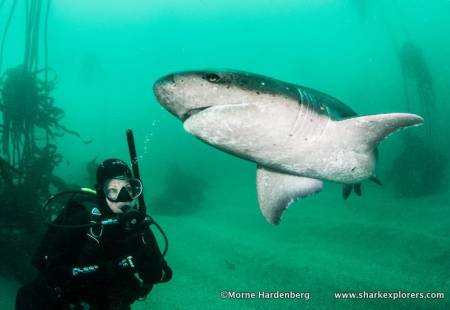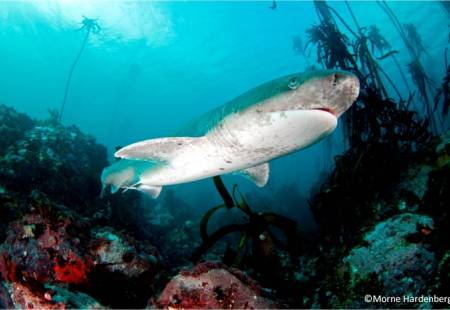

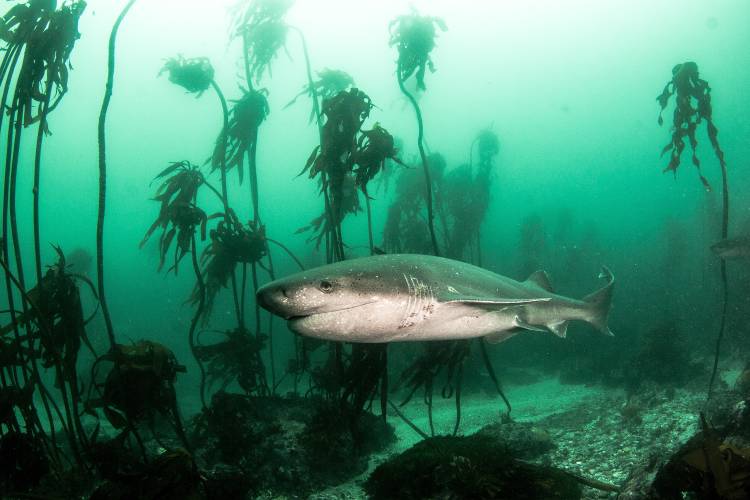
The sevengill shark research project has gained loads of momentum in the last two years following the support from the Two Oceans Aquarium and Woolworths and more recently from an underwater photo exhibition fundraiser.
Tracking sharks from Namibia to South Africa
Preliminary analysis of tag and recapture data from the Oceanographic Research Institute’s Co-operative Fish Tagging Program (ORI-CFTP) indicates that sevengill sharks are widely distributed in southern Africa, with catches recorded from Cape Fria in Northern Namibia to the Kei River mouth in South Africa. Interestingly, the majority of sevengill sharks were recaptured in the exact same location from which they were released, despite being free for multiple years. This provides evidence that sevengill sharks display site fidelity to specific coastal areas in South Africa, which is an important finding that can be used to advise placement of fishery restricted zones in order to protect critical habitats for this species. Despite the large number of recaptures that occurred in the same location from which sevengill sharks were released, a number of sevengill sharks were recaptured after undergoing large scale coastal migrations of up to 600 km! This highlights the complexity of the movement patterns for this species, which appears to range from long periods of residency in specific areas, to broad-scale coastal migrations.
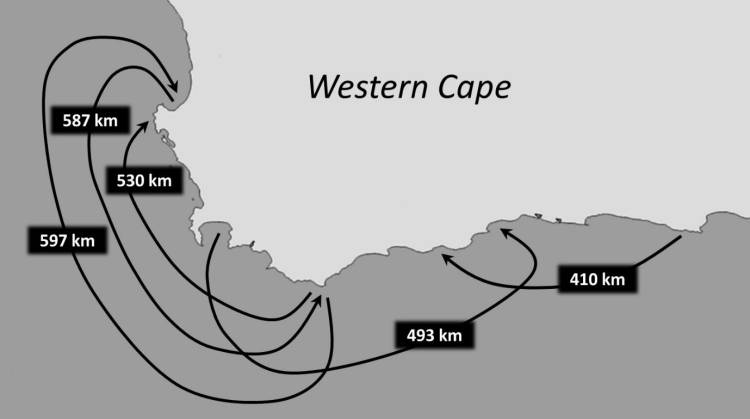
The tag and recapture data from the ORI-CFTP provides valuable preliminary insights into the distribution patterns, behaviour and broad-scale movement patterns of sevengill sharks in Southern Africa. Unfortunately biological data such as size and sex of captured individuals were not recorded in this dataset. Therefore what remains unclear is whether these biological factors influence patterns in habitat use, site fidelity, and the extent and timing of migratory behaviour. Quantification of sex- and size-specific behaviour and movement patterns for a species at both a local and regional scale is imperative in advising management and conservation strategies, in order to assess regional population demography and connectivity, protect habitats critical to the survival of the species across all life stages, as well as to prevent overexploitation of a particular sex or size class due to overlap with intensive exploitation pressure from fisheries in certain areas.
To read more about these results please visit the ORI tagging newsletter.
Acoustic tracking sevengill sharks
To overcome the gaps of the catch and release data we use acoustic telemetry to further investigate regional demography and population connectivity, as well as sex- and size-specific patterns in habitat use and migratory behaviour of sevengill sharks in South Africa.
The acoustic transmitters emit a train of pings at 23 – 183 second intervals, containing a specific identity code unique to individuals. These pings are detected by an extensive array of acoustic receivers placed at various locations along the South African coast as part of the Acoustic Tracking Array Platform (ATAP) co-ordinated by SAIAB. Data generated via the ATAP are uploaded and stored in a national database that is accessible to all researchers in collaboration with SAIAB, which allows the tracking of multiple species over a broad geographical range in South Africa.
Until recently the network of receivers deployed along the South African coastline extended from the Eastern border of Mozambique to Hout Bay in the south-west, with large gaps in receiver coverage along the west coast of South Africa. However in 2015 and 2016 we expanded this network to include two new receiver sites at Robben Island and four in Saldanha Bay.
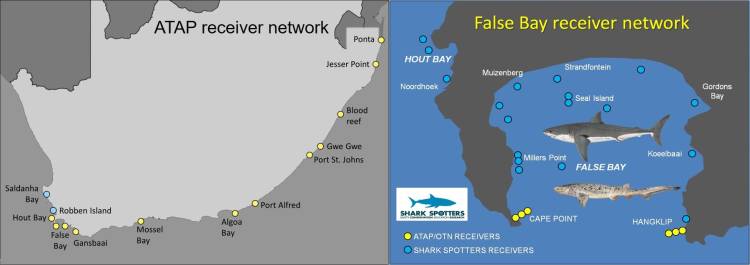
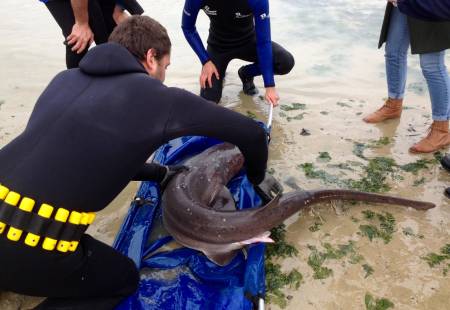
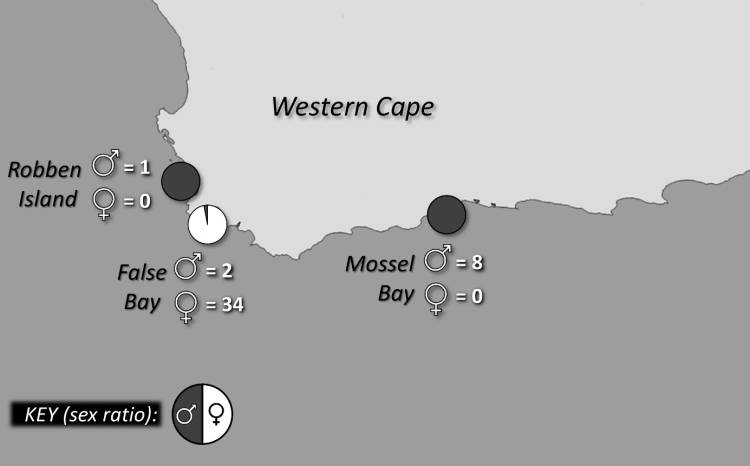
To date 45 sevengill sharks (34 females, 11 males) have been tagged with acoustic transmitters at three locations along the South African coast. Thanks to a new research partner, Oceans Research from Mossel Bay, we have added 8 male sharks to our study. So far, two of these male sharks have been detected on False Bay receivers. We have also recorded sevengills tagged in False Bay repeatedly visiting Mossel Bay and recorded three sevengills tagged in False Bay visiting Robben Island. This highlights that while sharks show temporary residency to certain sites, like Millers Point, they also move around a lot.
What’s next?
Following the increase in receiver coverage on the West Coast, our primary goal is now to increase tagging effort in this region, with the aim of tagging both mature and immature individuals of both sexes along the west coast between Robben Island and Saldanha Bay. Thus, we are very excited that on Monday 3 October we depart on an exciting research expedition for four days in partnership with Mike Horn and his Pole2Pole expedition. This will allow us to gain improved insights into regional patterns in demography and population connectivity between the west and south coasts of South Africa, and will facilitate investigation into migratory behaviour and the role of sex and/or size in habitat use, site fidelity, as well as in driving the scale, direction and timing of coastal movements. Finally, overlap with fisheries along the majority of the South African coast can now be investigated, in order to assess the vulnerability of sevengills to exploitation on a regional scale in South Africa, allowing advisement of a national species-specific management plan for these sharks.

Keep up to date with news from this expedition on the Pole2Pole and Shark Spotters social media pages.
For more information on this project you can read a recent article in the Save Our Seas magazine.