
Anyone who knows a birdwatcher, is related to one, or is one themselves, will know that it’s a hobby that grabs hold and does not let go. Birders, also known as twitchers, seem to have it all: peace and quiet and the great outdoors.
A major event on any birder’s calendar is the annual Sappi BirdLife South Africa Birding Big Day, due to take place on 27 November this year. It’s a fun but typically competitive day for South Africa’s birdwatchers, who number in their thousands.
Happening across the country on Saturday, birders will compete in a number of categories as they “tick” as many bird species as possible in 24 hours.
Believe it: participants do their thing from midnight to midnight and their tenacity results in impressive lists. While it may mystify you, birders will tell you there’s real magic involved in appreciating our natural heritage this way.
Birding Big Day is used as a platform to raise funds for BirdLife South Africa’s conservation work, which is targeted at threatened species, threatened habitats and biodiversity conservation. BirdLife partners with various NGOs on its projects, including education, across the country.
Did you know that the Aquarium hosts no less than eight bird species?
Penguin power
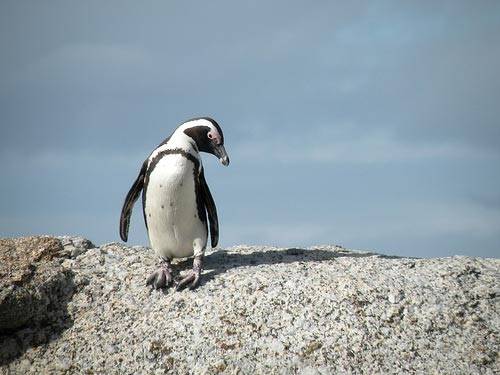
Our rockhopper, African and king penguins are a firm favourite with visitors.
Our seven rockhopper penguins are currently available for meet and greet sessions as part of our Penguin Encounter programme. Endlessly adorable, these rockies have incredible jumping abilities and are recognised as “mountaineers” among penguins.
Zuki and Ayoba are our African penguin ambassadors and together they raise awareness about this species that occurs only off the coast of Namibia and South Africa. African penguins are among our most important natural assets and their endangered status means that educating the public about the threat of oil spills and habitat destruction is crucial.
The king penguin is a truly grand bird and the second largest of all penguin species: they can grow up to 90cm tall. They do not hop, like other penguins, but rather walk – stately behaviour for seabird royalty.
BirdLife South Africa’s Save our Seabirds Fund is making waves in the area of seabird conservation and we salute their efforts.
The Cape’s crusaders
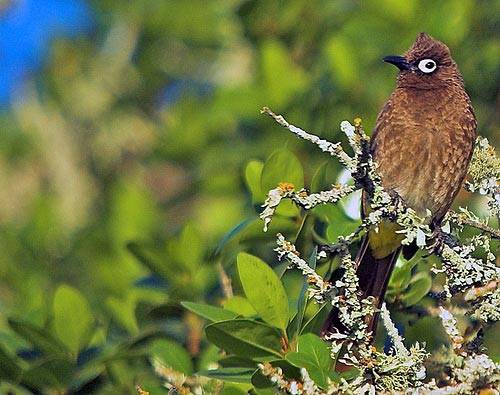
The Cape bulbul, Cape canary and Cape wagtail can all be seen in the Sappi River Meander and are a crucial part of intricate river ecosystems in South Africa.
According to the Sasol Bird e-guide, the Cape bulbul is “usually seen in pairs or small groups. It is a conspicuous bird, which tends to sit at the top of a bush. They are active and noisy birds [that eat] fruit, nectar and insects.” Look out for the bright yellow undertail and the white ring around the eye.
The Cape canary lives on the edges of open, treed grassland, in gardens, parks and cultivated fields. It’s a colourful and familiar sight around the Cape and indeed as far north as Zimbabwe. According to Biodiversity Explorer, the Cape canary is “monogamous and usually a solitary nester, although it sometimes forms loose colonies with up to 12 nests in a few adjacent trees.”
The Cape wagtail’s numbers have been slowly declining in some areas. It is usually found “near fresh water or coastal lagoons,” says Destination Kruger Park, “but has also adapted to city parks and gardens.” According to the Sasol Bird e-guide, the Cape wagtail “is very sensitive to the use of pesticides in insect control and may disappear from areas where pesticides are over-used.”
World favourite
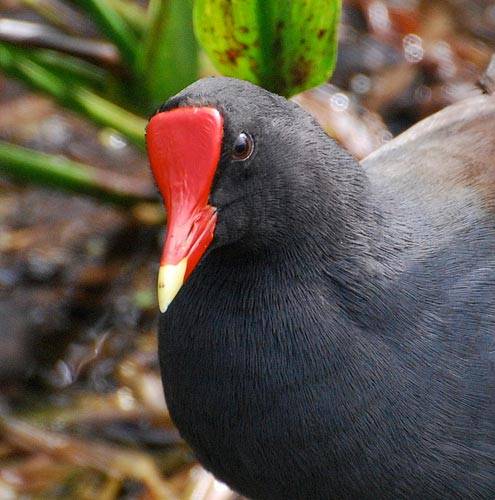
The common moorhen is found all over the world.
It is “the most widely distributed member of the rail family,” says All About Birds, that “inhabits marshes and ponds from Canada to Chile, from northern Europe to southern Africa, and across Asia to the Pacific.
“Vocal and boldly marked, the species can be quite conspicuous, sometimes using its long toes to walk atop floating vegetation.”
“Despite lacking either webbed or lobed feet, the common moorhen is an excellent swimmer,” according to WhatBird.com.
When it swims, the common moorhen “bobs its head back and forth; it is a better swimmer and walker than flier!” according to NatureWorks.
Black gold
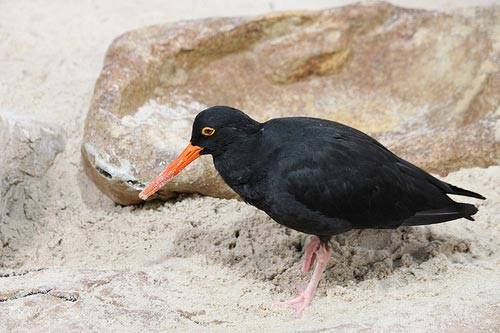
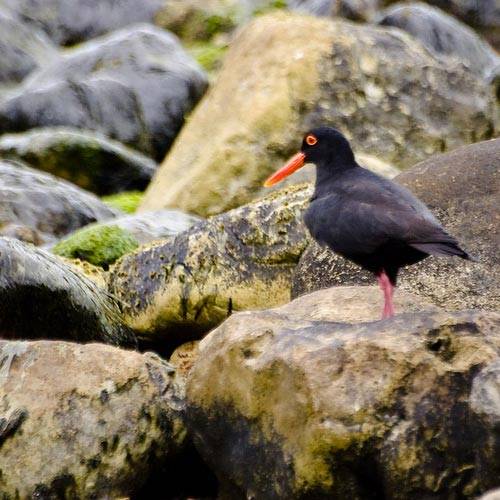
The African black oystercatcher is a conservation success story, albeit a tale of precarious balance.
In 1998, the African black oystercatcher was considered a threatened species and to protect it from further decline the Oystercatcher Conservation Programme was initiated by the Percy FitzPatrick Institute of African Ornithology at the University of Cape Town.
Due to the efforts of this programme and increased food availability, and thanks to the rapid spread of the alien Mediterranean mussel (Mytilus galloprovincialis), the number of African black oystercatchers is now on the rise.
It is predicted that the ban on beach driving will also have a positive effect on the species’ population growth, mainly by reducing mortality rates of eggs and chicks.
An African black oystercatcher chick (Haematopus moquini) hatched in the Sappi River Meander in 2003. As far as we know, this is the first time this endangered species has successfully bred in captivity.