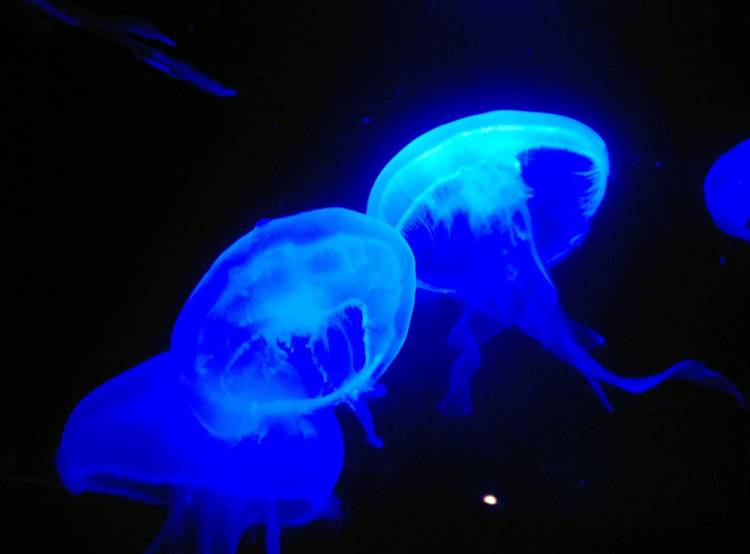
Meet the blue jellyfish or Catostylus mosaicus, which, surprisingly, is technically not a fish. They’re closely related to sea anemones and corals and range in colour from very light blue to dark purple and burgundy.
The image was taken by Chris Godden, a member of the Two Oceans Aquarium Flickr group.
Jellyfish have no eyes, but use light-sensitive organs on the outer layer of their bodies to distinguish between light and dark. The walls of the body and tentacles are so thin that oxygen and carbon dioxide can easily pass through.
Although these jellies have no vertebrae, they’re made up of 95% water, they are certainly not spineless as anyone who has been stung can attest to. And predators such as leatherback turtles and other marine creatures come up short dying in hordes every year from mistakenly swallowing drifting plastic bags which resemble the gelatinous jellies.
Jellies are considered a delicacy in Asia and it is alleged that Chinese people believe eating jellyfish reduces high blood pressure. Their texture is said to be crispy yet elastic, prompting the name “rubber band salad” for this dish sold in China, while dried jellies are also popular in Japan.
Find out more by visiting the blue jellyfish at the Oceans of Contrast: Atlantic Ocean Gallery at the Two Oceans Aquarium.
Been to the Aquarium lately? We’d love to see what you saw! If you have images that you’d like to share with us, join the Two Oceans Aquarium Flickr group and you could see your picture on our blog!