
At the end of August 2016, myself [Two Oceans Aquarium Senior Aquarist Nicholas Nicolle] and other key staff members attended the 45th Annual Conference of the Parasitological Society of Southern Africa (PARSA 2016).

I presented a talk on my Masters in Science research project, which involves using two different surgical techniques - coeliotomy and coelioscopy - to obtain liver biopsies in fish that are potentially infected with Icthyophonus hoferi in the Ocean Basket Kelp Forest Exhibit here at the Aquarium.
Many of the fish in the kelp forest here are very valuable specimens. Some have been here for 15 years or more, and are not easily replaced, as you don’t find the same size animals in the wild, let alone the species, anymore. Icthyophonus hoferi was first diagnosed in some deceased fish from the Kelp Forest and Seal Pool about two years ago in some of the dead fish that had been removed. Ichthyophonus has caused a number of major epizootics around the world, where massive die-offs have taken place.

The research on the diagnosis of Ichthyophonus is plentiful, however, these diagnoses were performed on dead samples through culturing, using microscopy or performing PCR [polymerase chain reaction: a laboratory technique used to make multiple copies of a segment of DNA] on the organs of the fish. With our fish being precious to us, the aim of my project is to determine which surgical method is better and to obtain liver biopsies and diagnose Ichthyophonus in these fish, without having to euthanise them.

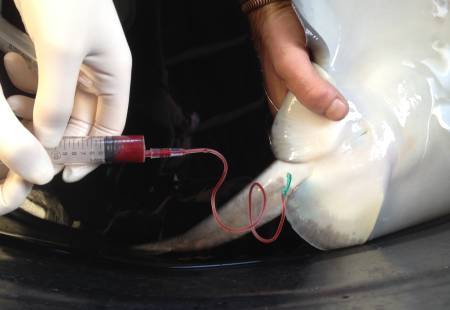
These liver biopsies are processed by microscopic wet mount, placed in culture media and used to run PCR to check for the presence or absence of Ichthyophonus. Once my surgeries are complete, I look after the fish for six weeks to evaluate healing and observe their post-surgery health by drawing blood and checking parameters such as packed cell volume (PCV), glucose, total proteins and doing blood smears to perform white cell counts.
Other presentations at PARSA 2016

There were loads of interesting presentations at PARSA this year. My supervisor Dr Kevin Christison from the University of the Western Cape presented a talk on nematode worms in bowmouth sharks. There were other very cool talks on Anisakis worms that are common in many of the fish we eat such as snoek, hake, kingklip, anchovy and herring, which also parasitise humans and can cause asthma and allergies in humans.
There were a few talks on frogs and the parasites they carry, and how the life cycles of the parasite have evolved with the frog to parasitise various stages of the frog through metamorphosis.
I will be keeping any copepods we find on our sharks or elasmobranches to send to Prof Susan Dippenaar who works for University of Limpopo, as she and her students need any samples available. Senior Aquarist Kevin Spiby and I will be keeping turtle samples for Prof Louis du Preez, as he is looking for a monogenean worm that can potentially be found under the eyelid of the juvenile turtles. There is a similar worm that causes hippos to blink more, which also parasitises the eyelid of hippos.
Another interesting and fairly new concept that Drs Cecile Reed and Carl van der Lingen are working on is using eye parasites as biological tags to identify different populations of pilchard and anchovy (either West Coast or East Coast populations), where they move or where they are caught. They are now using these methods on the deepwater and shallow water hake species (M.paradoxus and M.capensis).