From a sleepy giant bullfrog and a new green sea turtle to solution-inspiring sea cucumbers and a trip to Struisbraai, there never is a dull moment at the Two Oceans Aquarium!
Our giant bullfrog is hibernating
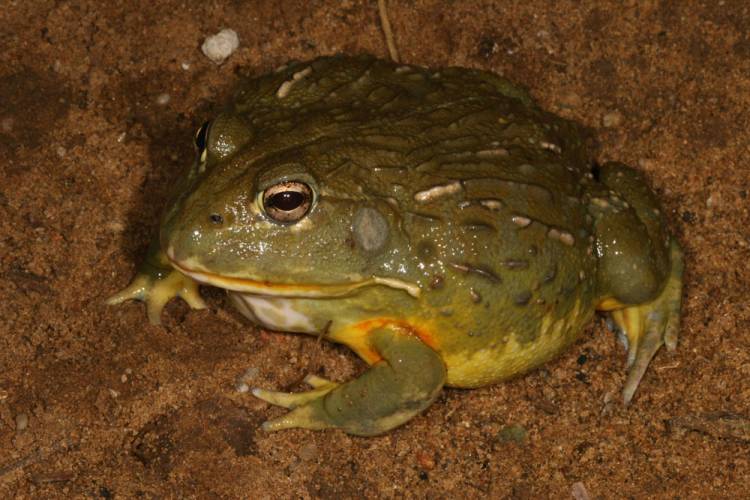
Giant bullfrogs live in areas where it rains during summer and is cold and dry in winter. As it starts getting cooler, and to prevent themselves from drying out, bullfrogs head underground where they hibernate until it gets warmer and the rains come.
To prevent water loss they create “cocoons” of moulted skin and mucous around their bodies with only small breathing holes over their nostrils. Bladder-like structures in their gut allow the bullfrogs to store up to 50% of their weight in water while they are underground.
With autumn on its way, our bullfrog’s body clock has told him that it is time to hibernate, even though it rains in winter in Cape Town.
New sea cucumbers
We introduced two sea cucumber species into the lionfish exhibit in the Oceans of Contrast: Indian Ocean Gallery: They are tapering sea cucumbers (Holothuria leucospilota) and tufted sea cucumbers (Holothuria cinerascens).
Sea cucumbers are echinoderms, which puts them in the same family as starfish. These unimposing animals have been the inspiration behind some amazing scientific developments. One of these is a new type of plastic that mimics the sea cucumber’s ability to quickly alter its skin’s flexibility.
Potential future uses for this plastic include brain implants to treat Parkinson’s disease or spinal injuries, bulletproof vests that can be “turned on and off” at will, and specialist casts that can be strengthened and softened as needed.
Newcomers to the I&J Predator Exhibit
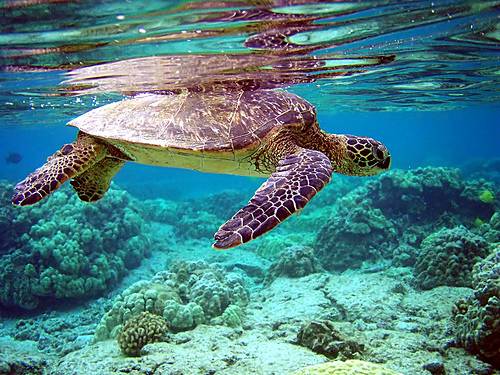
We have two new residents in the I&J Predator Exhibit: A brindle bass (Epinephelus lanceolatus) and a green sea turtle (Chelonia mydas).
The brindle bass, nicknamed Buzz, was given to us by Bayworld in Port Elizabeth. Brindle bass are the largest and most territorial of the rock cods and can grow to an enormous 2.7m and 300kg.
The green sea turtle, Cannelloni, was found by a Marina da Gama resident on Sunrise Beach (Muizenberg) in December 2009. Like all turtle species, green sea turtles prefer warm water and suffer if they spend too much time in cold water.
Cannelloni was rehabilitated by our aquarists and introduced to the I&J Predator Exhibit in March.
Green sea turtles, as their name implies, are olive-green in colour with a relatively smooth carapace – that’s “shell” in me-and-you speak. They have a short snout and their beak is not hooked like the loggerhead turtle’s. Adult green sea turtles eat mainly seaweed and sea grass and can often be seen close to shore, basking at the surface of the water.
See also:
Collections
Our collections team is currently in Struisbaai collecting small fish for our cold reef exhibit in the Oceans of Contrast: Atlantic Ocean Gallery. The Struisbaai trip is a good training opportunity for our aquarists, and this year Ruth Wright, Pierre de Villiers and Xolela Batayi have joined Vincent Calder and Angus Nel on the expedition.
During their trip, the aquarists will get a feel for where our fish come from, how we collect them, how we deal with them after collection, and what it feels like to go to sea off the southern tip of Africa!