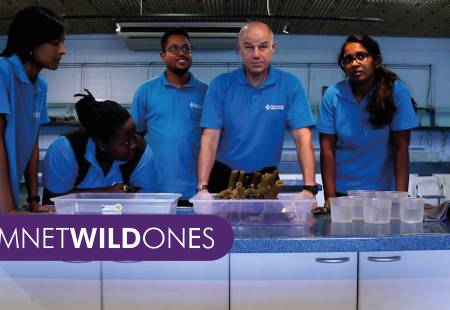

Prior to the commencement of the national lockdown, the Two Oceans Aquarium Education Foundation ran the Marine Discoverer course, a five-day dive into marine science subjects for Grade 8 learners. Thanks to sponsorship from the American International School of Cape Town, 47 committed youngsters could participate free of charge, and we're pleased to report that all 47 completed the course with excellent results!
_750_500_70.JPG)
On the first day of the course, the learners wrote a short test to assess their prior knowledge of the marine sciences - this would set the benchmark by which we could gauge the effectiveness of the course. It was then time to launch into the lesson! Lessons on day one delved into South Africa’s marine ecosystems and the processes that shaped them. This included a lot of geology content such as an understanding of geological time, the origin of the planet, plate tectonics and the topology of the ocean floor.
_600_600_70.jpg)
_750_563_70.jpg)
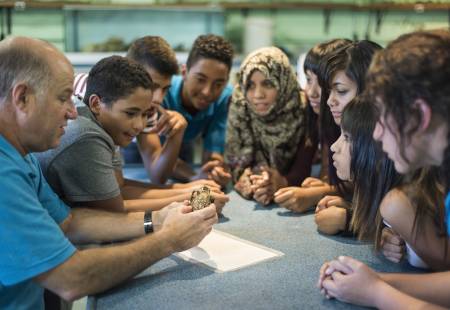
Day two focussed more on the evolutionary processes that have resulted in life as we know it. We kicked things off with an activity about natural selection, followed by lessons about basic life processes, symmetry in living things, and taxonomic classification. The day ended off with examples of live molluscs for the learners to observe and identify, as Mollusca was the one main phyla dealt with in this course.
_600_600_70.jpg)
_600_600_70.jpg)
_600_600_70.jpg)
Topics for day three included understanding water parameters, such as pH, and the Cape's rocky shore ecosystems, the open ocean, atmosphere and currents. It may seem like these topics were disjointed, but they were all building on the students’ knowledge in order to apply content to the rocky shore fieldtrip and scientific enquiry task at the end of the week.
_600_600_70.jpg)
_600_600_70.jpg)
_600_600_70.jpg)
Finally, it was time for the field trip! Day four started very early as low tide was at 07h30 and this was the best time to go and observe animals in the four rocky shore zones and to collect data.
_600_600_70.jpg)
_600_600_70.jpg)
Once we returned to the Aquarium we continued with lessons about macroalgae (seaweeds) and the phylum Arthropoda, students were fortunate to have live baby lobsters on the table to observe. Alexandra Panagiotou, our Greek intern who assisted with the course, covered the topic of human impacts on the ocean with the learners. Groups of learners received articles to read about various human impacts on the environment, and had to present back to the class - which ended up being very engaging.
_600_600_70.jpg)
_750_563_70.jpg)
On day five, the group received a brief introduction to scientific enquiry, as the final topic and practical component for the course. This was in order to prepare them for the scientific investigations they would be part of at a tertiary level, so working in groups they needed to compile a hypothesis, use the data they had collected at the coast, decide on a conclusion, create a poster and present on their findings to the class.
_750_563_70.jpg)
_750_563_70.jpg)
_600_600_70.jpg)
By the end of the course, it was clear that we had 47 young marine scientists on our hands! We would like to thank the team of educators and volunteers that presented this course. Finally, this course would not be possible without our generous sponsors, the American International School of Cape Town. We are truly thankful for the opportunity.
_450_310_70_s_c1_c_t.jpg)