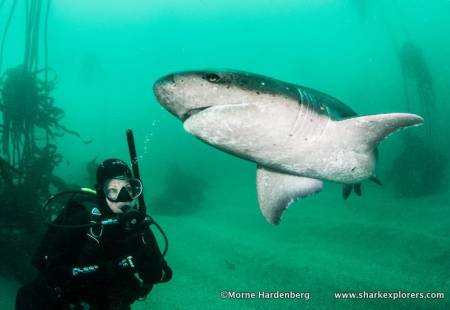

The last few days have hinted at spring and the promise of summer is on the horizon. For many people that means spending more time at the beach and swimming, surfing and kayaking in the sea. It is also that time of the year again when in-shore shark activity increases in False Bay and a greater number of great white sharks frequent the in-shore area.

The City of Cape Town and the Shark Spotters encourage all beach and ocean users to be shark aware and to be responsible when playing in the ocean.
"Typically, shark sightings start in late August, and continue through to April, with most sightings being reported in mid-summer. We are also asking surfers to be especially vigilant in the areas between Sunrise and Macassar beaches as research has shown that the presence of sharks is extremely common at this time of year," said the City’s Mayoral Committee Member for Energy, Environmental and Spatial Planning Councillor Johan van der Merwe. "Together with our partner, the Shark Spotters, we will do everything in our power to enhance the safety of beach goers and ocean users over this period. We also urge members of the public to play their part, to be proactive, and to act as their own 'safety officers' first."
General shark safety tips include:
- only using beaches where the Shark Spotters are on duty
- taking the time to speak to the Shark Spotters on the day you visit the beach
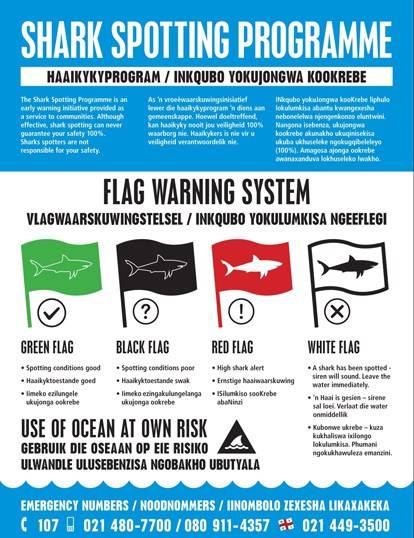
- using the Shark Spotters signs to familiarise yourself with the four-flag warning system and warning siren
- not swimming, surfing or surf-skiing when birds, dolphins or seals are feeding nearby
- not swimming, surfing or surf-skiing where trek-netting, fishing or spear-fishing is taking place
- not swimming in deep water beyond the breakers
- not swimming if you are bleeding
- not swimming near river mouths
- not swimming, surfing or surf-skiing at night
- not swimming, surfing or surf-skiing if there has been a whale stranding nearby
- obeying beach officials, lifeguards and the Shark Spotters if told to leave the water
- being aware that the rate of encounters with white sharks rises significantly when the water temperature is warmer (18ºC or higher) and during new moon, due to increased opportunities for feeding
- considering using another beach if a shark has recently been sighted in a particular area where no Shark Spotters are present
- asking the local law enforcement official, lifeguards or locals about the area if you are a first-time user
- paddling in groups, and staying close together (in a diamond formation) for those who are kayaking or surf-skiing far out to sea
- considering the use of a personal shark shield when you go surfing or kayaking
- paying attention to any shark signage on beaches
The Shark Spotters Information Centre, which is situated at Muizenberg Surfer’s Corner, is open to members of the public from 08:00 to 18:00, seven days a week. The centre provides up-to-date information on sharks and marine ecology, basic first-aid, general public assistance and emergencies, storage of valuables, and lost property.
The Shark Spotters will also be present at the following other beaches from October 2016 to April 2017:
- St James/Kalk: Bay Monday – Sunday, 08:00 – 18:00
- Fish Hoek: Monday – Sunday, 07:00 – 18:45
- Caves, Kogel Bay: Monday – Sunday, 08:00 – 18:00
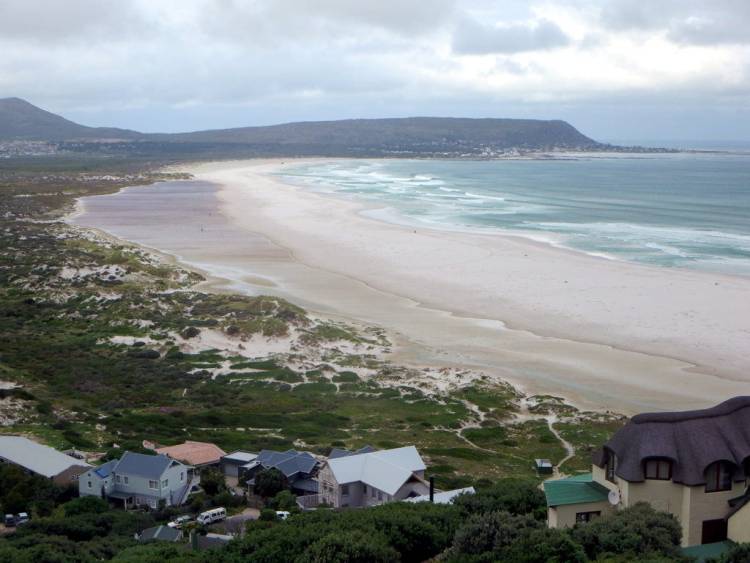
- Noordhoek (The Hoek) Monday – Sunday, 08:00 – 18:00 (September to May)
- Clovelly: Weekends, public holidays and school holidays, 10:00 – 17:00
- Glencairn: Weekends, public holidays and school holidays, 08:00 – 18:00
- Monwabisi: Weekends, public holidays and school holidays, 08:00 – 18:00
In addition, the Fish Hoek shark exclusion net will be in operation from October 2016 to April 2017. The net will be deployed for the annual Fish Hoek Spring Splash on 4 September 2016. The Shark Spotters will keep beach users informed via Twitter and Facebook as to whether the net is deployed.
For more information on the latest shark sightings and research, please visit www.sharkspotters.org.za or follow the Shark Spotters on Twitter (@SharkSpotters) and Facebook (www.facebook.com/SharkSpotters). Members of the public are encouraged to report any sightings of white sharks to the Shark Spotters.