
The Two Oceans Aquarium Environmental Education Centre runs several holiday enrichment courses, known as the Marine Science Academy, for young natural historians with a particular interest in marine topics. As they progress through the courses and climb the grades, many of them express an interest in pursuing a marine-related career. This generally starts off wanting to be marine biologists, but further guidance makes them aware of the huge variety of careers on offer. The Marine Science Academy culminates in two five-day academic courses offered to grade 11 and 12 learners, one covering the aspects of zoology and the second oceanography.
We were overjoyed to hear that the 2018 courses would continue to receive sponsorship from I&J. Application forms were sent to local schools and we settled on 46 candidates. We were also happy to accept three applications from further afield in South Africa and one from Canada! It would seem the courses offered by the Two Oceans Aquarium are a unique opportunity, globally.
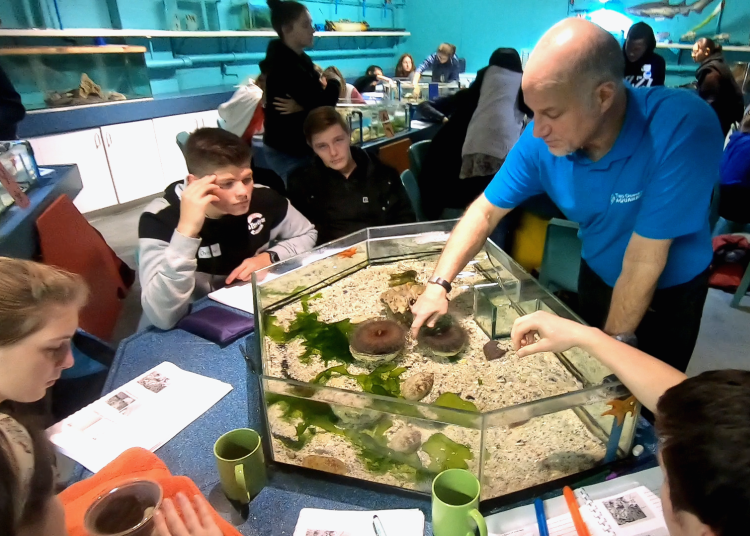
Over the school holidays we ran the Zoology section - let's take a look.
The first day of the course sets out to define biological functions, to introduce levels of complexity and body plans in organisms and to establish an understanding of animal taxonomy. With these broad concepts in place, all the major animal phyla are introduced over the next four days, starting with Protista and ending with Mammalia, paying special attention to marine examples. In each case, the evolutionary process is highlighted to show progression and "innovative" adaptations in each new phylum.
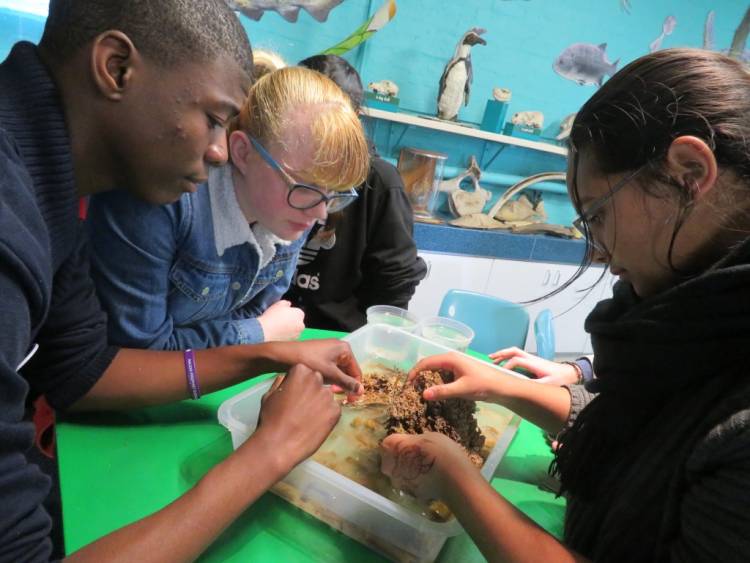
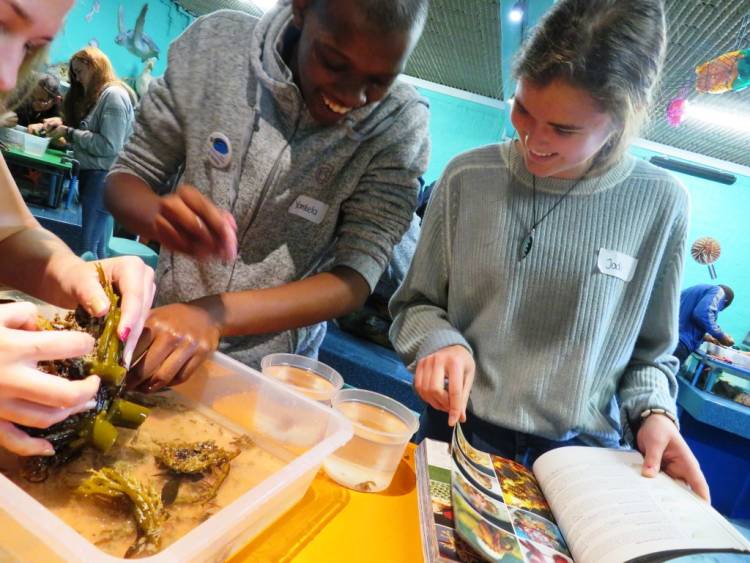
The increase in complexity and move to life onto land is dealt with as a theme, particularly in the vertebrate classes and it is also noted, especially for each of the land-living vertebrate classes, how some of them have evolved the ability to live in the oceans again from structures clearly meant for life on land. For each phylum, we tried to have live animals and dry exhibits in the classroom for the learners to view and compare. We also performed kelp holdfast dissections - kelp holdfasts house a range of invertebrates; these were carefully extracted by students working in groups of six and kept in tanks to view later in the week.
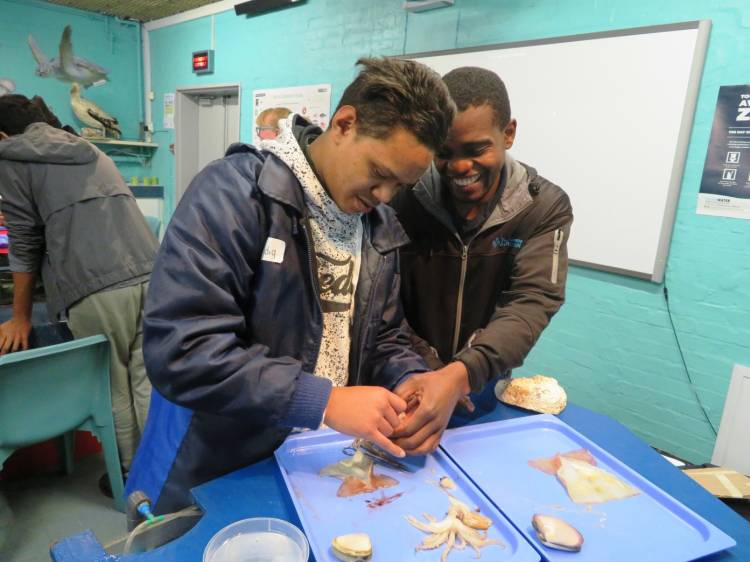
Time was also set aside to do dissections of crabs, squids and fish; using animals that were destined to be prepared as food for the Aquarium's animals.
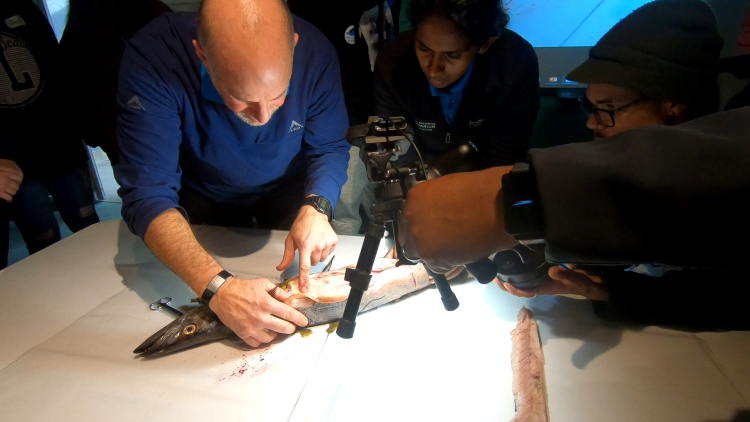
A highlight was a demonstrated dissection of a large snoek. Being much larger than the pilchards, which everyone had dissected, it was far easier to see and point out finer details of fish anatomy.
Students spent time in the Aquarium during longer breaks, so that they could find examples of the animals discussed. As an added incentive for them to observe the animals, we ran a photography competition: The candidates were encouraged to take photos of as many of the animals as possible and to submit them via Instagram. Aquarium staff viewed all the photos on the last day and prizes were awarded for the top two photos.
The course was unashamedly academic in nature, in keeping with what will be expected at tertiary level. A pre-test was done, based on the content to be covered so that the level of prior knowledge can be established. The pre-test result for the course was an average of 24%. The candidates rewrote the test at the end of the course, and attained an average of 76%, indicating that significant learning was taking place.
Another assessment for this course was to write a comparative essay to be completed and submitted after the course. Several options were provided, from which one needed to be chosen. These serve as an opportunity for the candidates to be able to consider and synthesise all the work covered in the week. This is a particularly useful final assessment, given that the synthesis involves higher order thinking and that most candidates were unfamiliar with writing longer essays as a form of assessment - a form of assessment which is used extensively at tertiary institutions.
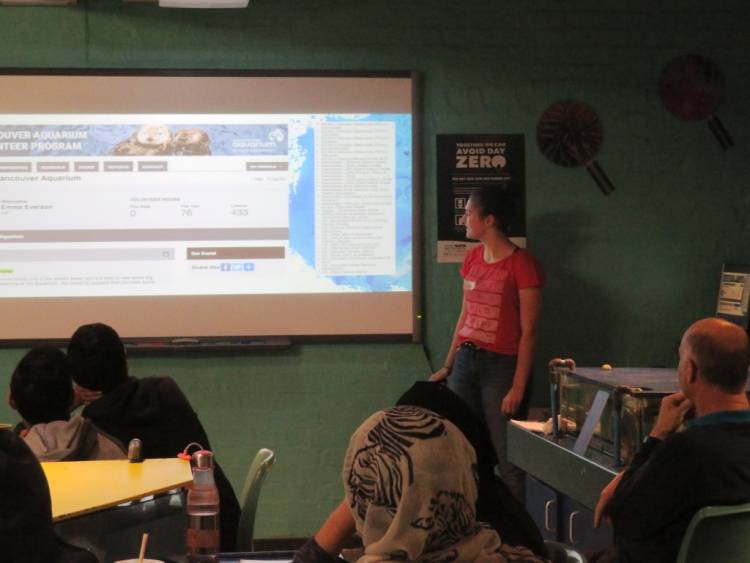
Feedback from the students was unanimous in praise for the enthusiastic presenters, the ability to work with and view live animals in the Aquarium and to I&J for providing the sponsorship which made this experience possible. We would also like to thank our volunteer assistants - university students pursuing careers in marine sciences who were former graduates of our Marine Science Academy. Thanks!
Ocean education for your kids
There are many ways your children can get involved in environmental education opportunities at the Aquarium. Here are a few of the most popular options:
- School classes, youth groups and other organisations can book a classroom visit that fits in with your curriculum:
- Pre-school: A wide range of interactive Puppet Stories, from I Love Turtles to a Water Cycle Adventure.
- Grade 1-3: Discover underwater wonders and learn about different kinds of fish.
- Grade 4-6: Fun lessons with topics from fish anatomy and marine conservation to the close relatives of sharks.
- Grade 7-9: Lessons from water conservation to rocky shore ecology.
- Grade 10-12: Exciting topics from sharks and ecotourism to biodiversity and anatomy.
- Individual children of all ages can take part in FREE courses from our Marine Science Academy:
- Grade 6: Become Junior Biologists and study marine life and conservation on our coast.
- Grade 7: Learn Smart Living and learn how our lives and the environment interact (next course's closing date on 27 July)
- Grade 8: Become a Marine Science Discoverer if you're in grade 8 and learn about careers in ocean science.
- Grade 9: Become Marine Science Explorers - time to get hands-on with ocean life.
- Grade 10: Apply for our flagship Young Biologist course, and jumpstart a marine career.
- Grade 11 & 12: FET Zoology and Oceanography courses - a stepping stone into marine science tertiary studies.
- If you can't get to the Aquarium, we'll come to you!
- A fully equipped mobile aquarium, Oceans in Motion, is on the road - bringing the ocean's wonders and lessons to previously disadvantages schools in the Cape Town area.
- The Smart Living outreach programme engages with learners on key environmental issues such as energy, water, waste and protecting biodiversity.
If you would like to make a booking for your class, get involved in one of the above courses or are an adult looking for training opportunities or to take part in our job shadowing programme, please visit our Environmental Education Centre portal for more information and the relevant contact details.