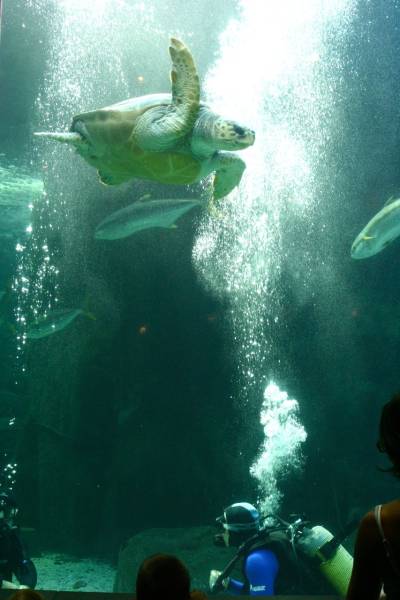
Happy World Turtle Day! Today, 23 May, was first set aside by American Tortoise Rescue in 2000 to celebrate these reptiles of the sea. At the Two Oceans Aquarium, you can see a loggerhead turtle or two – look out for Yoshi in the I&J Predator Exhibit.
Win tickets with turtle trivia power
In May, you stand the chance of winning one set of double tickets to the Two Oceans Aquarium – one of the top tourist attractions in Cape Town. More than 3 000 living sea animals, including sharks, fishes, turtles and penguins can be seen in this spectacular underwater nature reserve.
To enter, you’ll be asked to fill out this quiz which concerns turtles. Why turtles, you ask? Because 23 May is World Turtle Day!
Turtles – dinosaurs of the oceans
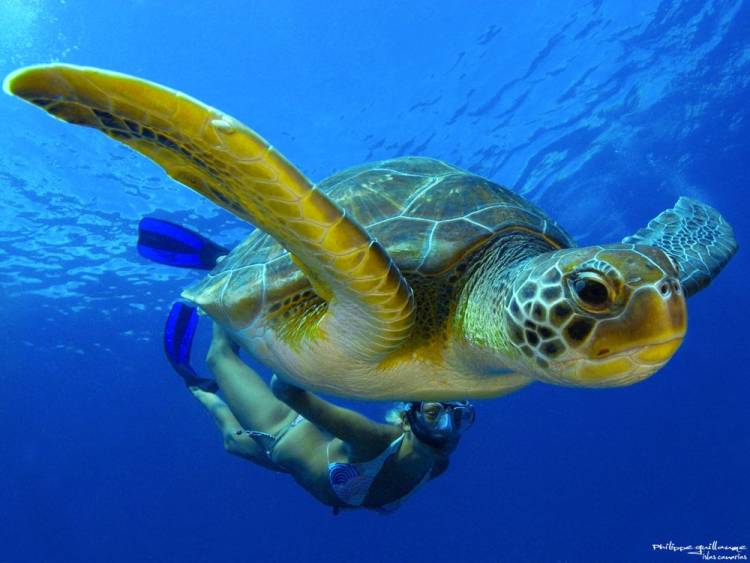
Sea turtles are living dinosaurs, having survived some 90-million years from the Age of the Reptiles. While people are fascinated by these ancient creatures because of their link to the distant past, and the fact that they have not changed significantly in all these years, turtles are now endangered and threatened with extinction. Recent estimates of the global population of leatherback turtles alone indicate that numbers have fallen by two-thirds since 1980 and continue to plummet (Earthwatch, May/June 1997).
There are seven species of turtles: leatherback (Dermochelys coriacea), green turtle (Chelonia mydas), hawksbill (Eretmochelys imbricate), olive ridley turtle (Lepidochelys olivacea), loggerhead (Caretta caretta), flatback (Chelonia depressa) and Kemp’s ridley turtle (Lepidochelys kempi).
However, only five species occur in the waters off southern Africa. Loggerheads and leatherbacks nest on the north coast of KwaZulu-Natal while the green turtle occurs as a non-breeding resident and the hawksbill and olive ridley as strays (Hughes,1989).
Amazing adaptations
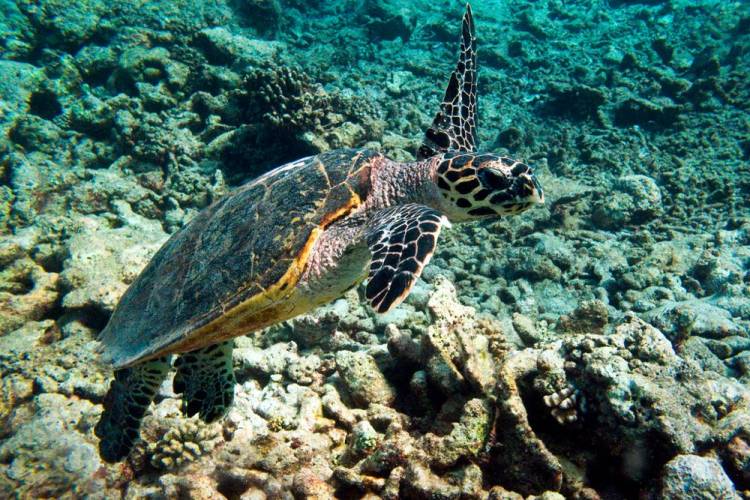
Although turtles breathe air, using lungs as mammals do, and come ashore to lay their eggs that can only develop on land, they are exquisitely adapted to life in the ocean. The carapace (shell) of the turtle is streamlined and the bony elements have been reduced so that the gravity of the carapace is similar to that of the sea. Although they appear clumsy and slow on land, turtles are powerful swimmers, using their flat, broad front flippers to propel them through the wate,r and the smaller back flippers as rudders.
Their sensory organs have evolved to function efficiently underwater. Turtles have good underwater vision, but their eyesight on land is poor. The popular myth that turtles are crying when nesting due to the “pain” is based on the fact that turtles have special glands situated next to the tear ducts. These glands excrete excess salts in solution and, while this process occurs continuously, it is obviously more noticeable when the turtle is out of the water.
Hearing in turtles is poorly developed and “the eardrum is covered by ordinary skin which greatly reduces sensitivity” (Bustard, 1972). Turtles can hear low notes the best and are sensitive to vibrations on land and in the water.
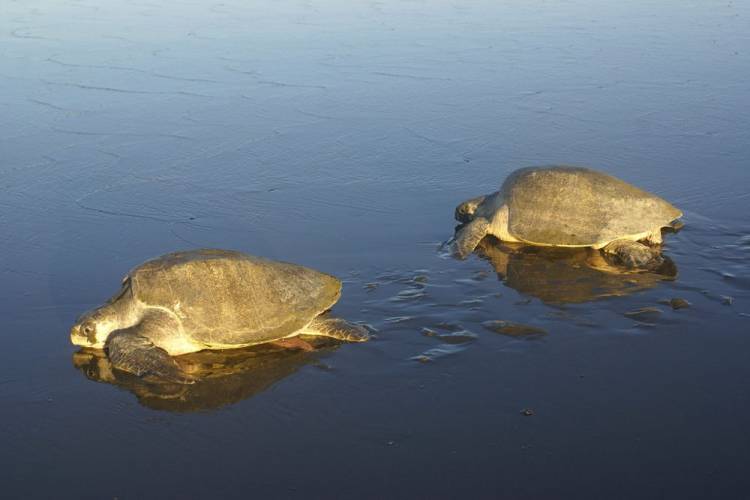
Most turtles have a keen sense of smell, and sea turtles are unlikely to be exceptions.
Turtles are air-breathing animals and, due to their watery habitat, need to hold their breath for long periods of time. Thus they can fully inflate their lungs and draw off as much oxygen as possible. When sleeping or hibernating (on the bottom), they have wonderful adaptations for surviving for hours or even months underwater.
Unlike many lizards and snakes which bear live young, like crocodiles, turtles lay eggs. Mating occurs at sea, usually near the surface, and fertilisation occurs internally. Females come ashore to lay great numbers of eggs in specially dug ‘nests’ high up on the beach.
Turtles are defenceless animals, having only their shell to protect them. Unlike tortoises, they cannot completely withdraw their heads and limbs into their shells. In the oceans, it is only their large size that offers some protection from predators. Sharks and whales have been known to prey on turtles. The turtle’s greatest enemy is Man, who destroys their nesting sites, plunders nests for eggs, kills them for food and, in the case of hawksbills, for their tortoise-shells.
Turtles in South Africa
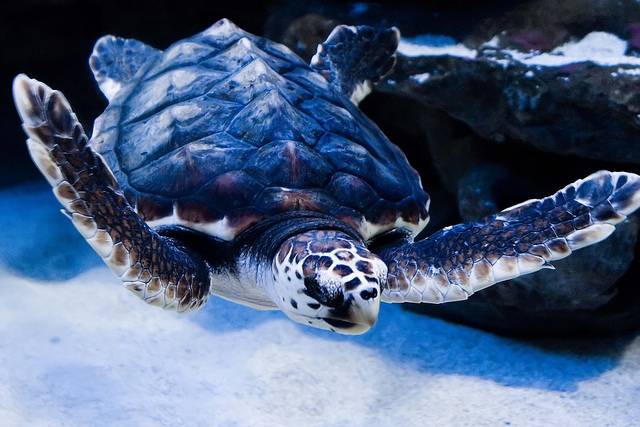
As mentioned previously, only loggerheads and leatherbacks nest on the South African coast, although green turtles are very common offshore.
Green turtles, as their name implies, are olive-green in colour with a relatively smooth carapace. They have a short snout and their beak is not hooked as in the loggerhead turtle. Adult green turtles feed mainly on seaweed and seagrass and thus can often be seen close inshore, basking at the surface. Female green turtles lay up to 150 eggs every 12 days or so, totalling approximately 600 eggs per season. Nesting occurs on the islands off Mozambique and other Indian Ocean islands. On some of these islands, the green turtles have been hunted almost to extinction.
The I&J Predator Exhibit in the Two Oceans Aquarium used to house a green turtle, Wasabi, but she was sent up north to warmer waters when her arthritis worsened in our colder water.
The loggerhead turtle, the most common in southern Africa, has a reddish-brown carapace and a hooked beak. Adults gain a maximum mass of 125 kg and measure up to 1,2m in length. Loggerheads feed predominantly on sea urchins, molluscs and hermit crabs, which they crush with their powerful jaws. Females nest on the northern beaches of KwaZulu-Natal and lay 100 to 120 eggs every 15 days during summer.
You can visit Yoshi our loggerhead turtle in the I&J Predator Exhibit.
Leatherbacks can be distinguished from all other species purely by their great size, and can measure up to 2,5m in length and weigh up to a staggering 1 tonne. These turtles are the second largest living reptiles! Considering the huge size they attain, it is remarkable that these animals feed almost exclusively on jellyfish. During a nesting season, females lay up to 1 000 billiard-ball size eggs in batches of 100 to 120 every nine to 10 days.
The nesting season
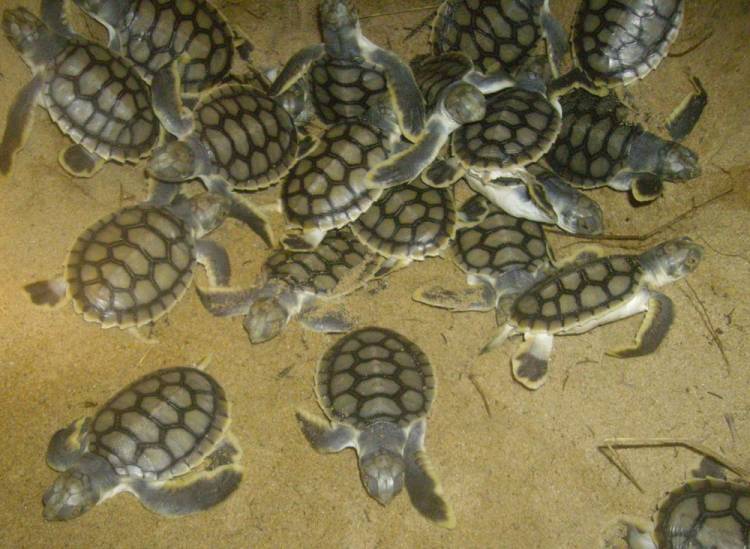
The nesting season for loggerheads and leatherbacks takes place along the sandy beaches of northern KwaZulu-Natal from October to February, coinciding with the presence of warm oceanic water (Hughes, 1989).
Males and females gather off the coast in September and October and mating occurs offshore in the water. Male turtles have specially adapted long, curved claws on their foreflippers, which they use to grasp the front of the female’s carapace (Hughes, 1989). It is while mating that males are particularly vulnerable and easily harpooned by man.
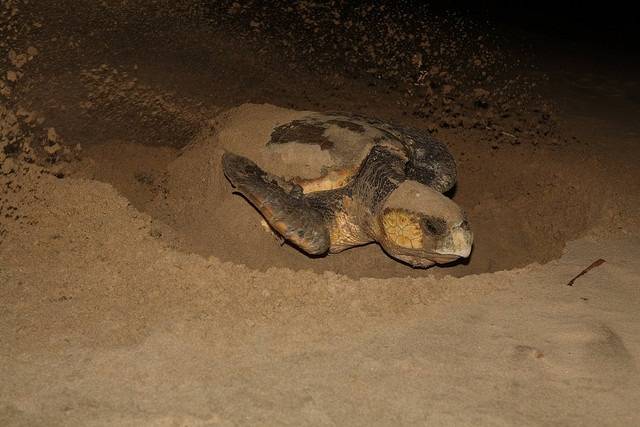
Females come ashore after dark, most often using the high tide to facilitate their clumsy movements on land. Remarkably, female turtles tend to return to the same beach every season to lay their eggs. It seems that each beach has its own scent and females use this scent to orient themselves. Once ashore, the female turtle briefly surveys the beach for any threatening movements, etc. The slightest disturbance, such as torchlight or people coming too close to her, will send her straight back into the sea.
Loggerhead females tend to make small nests in the dunes while leatherbacks dig huge nests of approximately 10m square just above the high watermark. This renders the nests vulnerable to intrusive beach traffic. To build the nest, the female turtle uses her front flippers and, with great sweeping motions, creates a large hole into which she steadily digs herself. Then using her smaller hind flippers, she meticulously scoops out a nest chamber of approximately 40-cm deep, patting down the sides to prevent them from caving in. Having completed the chamber, she then lays hundreds of white, soft-shelled eggs, the size depending on the particular species. Once the eggs are laid she carefully deposits sand into the chamber with her hind flippers, leaving a small space between the top of the eggs and the surface of the beach (Hughes, 1989). Then, using her front flippers, she vigorously sweeps sand over the chamber to disguise the site.
The eggs incubate for a period of 55 to 60 days, usually hatching between January and March. An interesting phenomenon is that the sex of the hatchlings is determined by the temperature of the clutch during the first three to four weeks of incubation. If the clutch is laid at temperatures from 20 to 24ºC, the hatchlings will most likely all be male. If the clutch is laid at temperatures of 29 º C and higher, the hatchlings will be predominantly female.

The entire batch of eggs hatches at the same time, with each hatchling using an eggtooth on the top of the beak to break out of the egg. After a brief period of waiting for their shells to straighten out and harden, the baby turtles begin to make their way to the surface. This can take three to four days days.
The hatchlings remain just under the surface of the sand until the beach temperature drops below 26ºC and then they emerge, usually at twilight. The hatchlings rarely emerge during the day as the threat of predation by birds, and the hot sand, would kill them immediately.
Using a light source such as the horizon or the moon, the hatchlings head for the sea. This journey is a dangerous one as they are exposed and vulnerable to predation by crabs and other nocturnal animals. In some countries around the world, where illuminated roads and promenades run parallel to the beach, the baby turtles head blindly for this light source and are killed by passing cars.
Once in the water, the hatchlings swim through the breakers and out into the warm Agulhas current.
A low percentage of hatchlings will survive to maturity, approximately only one in 1000. The young animals will spend months in the Agulhas current and several years in the great gyres of the Indian Ocean, returning to the coast of Africa as sub-adults.
Threats to sea turtles
All seven species of turtles are threatened with extinction. This is largely due to various human activities. One of the major reasons for this status is the continuing loss of nesting habitats.
Increased human presence on beaches, particularly at night, disrupts nesting females. They may be forced to use less suitable sites or abort egg-laying completely. Recreational activities on beaches, along with umbrellas, deck chairs, small boats and 4x4 vehicles, damage potential nesting sites and even destroy existing nests.
Poaching ranks as another major threat. Nests are raided for the eggs which provide food for the local people.
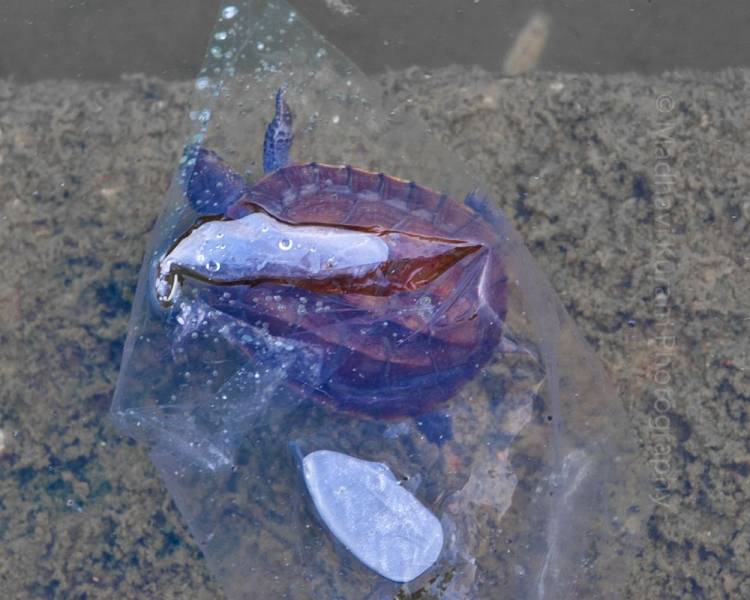
The ingestion of litter, particularly plastic, has serious and lethal consequences for turtles.
Leatherbacks mistake plastic bags for jellyfish. Plastic is not only toxic, but also obstructs the stomach and prevents the turtle from receiving nutrition from its food. The result is a lingering death.
Other threats include artificial lighting from buildings, street lights, etc that disorient hatchlings; building sea walls, jetties etc; beach erosion; beach cleaning; commercial fishing (turtles are accidentally caught up in gill nets) and oil and gas exploration.
As they make their way from the nest to the sea, hatchlings are particularly vulnerable to predators. Gulls, mongooses, leguaans, crabs and even ants attack the baby turtles. Once in the sea, large fishes also prey on them.
Stay in touch: For daily Aquarium updates, follow us on Twitter (@2OceansAquarium) and become a fan on Facebook.
References
Bustard, R. 1972. Sea Turtles: Their natural history and conservation. Collins, Great Britain. pp11 -22
Branch, G. , Griffiths,C.L., Branch, M.L. & Beckley, L.E. 1994. Two Oceans: A Guide to the marine life of southern Africa. David Philip Publishers, Cape Town. pp286
Chater, S. 1985. The Biology of the Tongaland Loggerhead Turtle with aspects of its reproductive behaviour. Unpublished report.
Hughes, G.R. 1989. Sea Turtles in Oceans of Life off Southern Africa. Payne, A.I.L. & Crawford, R.J.M. (Ed). Vlaeberg Publishers, Cape Town. pp. 230-243