
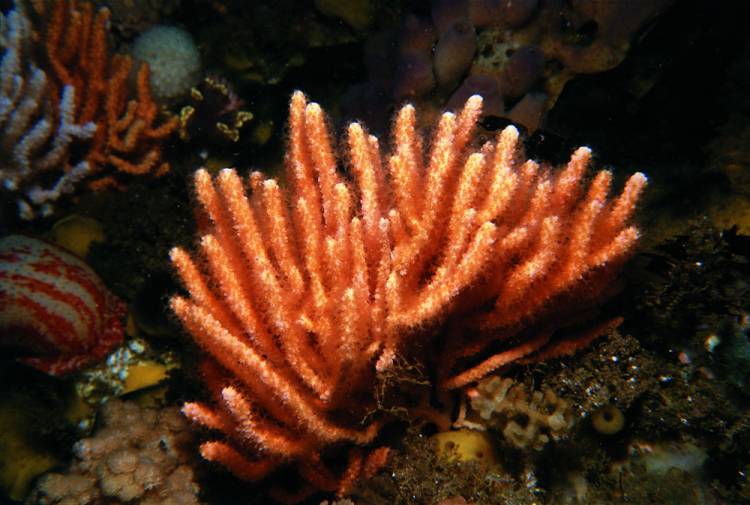
If a mythical mermaid were ever to scour the ocean floor for the perfect evening accessory, the sea fan would surely be it. These graceful gorgonians (also known as sea whips) are found in oceans around the world, but are particularly prevalent in the tropics and sub-tropics. Often brightly coloured, these beautiful, mainly nocturnal animals would match any underwater evening gown – be it red, yellow or purple.
Sea fans got their name because they closely resemble the air-moving devices women are so fond of batting their eyelids behind up here on dry land. They normally stand erect and flat; branch-like, with a colony of polyps that extend both high and wide. Some can reach a height of 2m and live for up to 100 years, although they grow only around 1.5cm per year. These creatures are never more than a few centimetres thick; they can appear two-dimensional, bushy or whiplike, while some are even encrusted like coral.
The elegant sea fans aren’t out to impress anyone though – they’re simply trying to feed themselves. The polyps are effectively organic sieves, each using eight tentacles to catch plankton as it wafts by on the current. This process of filter feeding is where the fan’s expanse comes into play; a colony of polyps is orientated across an established current like a net, to maximise the flow of water and consequently the supply of food. In the world of gorgonians, size really does matter, but it also pays to be thin! Sea fans mainly extend their polyps at night, when their chances of sifting plankton from the water are higher.
The structure of these fascinating sea fan colonies varies according to suborders: Holaxonia skeletons are made of gorgonin (a flexible, horny substance), while Sclerazonia sea fans are held up by calcareous spicules that are clustered tightly together. Most sea fans belonging to these two suborders anchor themselves in mud or sand, rather than attaching themselves to a hard substrate.
Gorgonians can contain algae or zooxanthellae, which exist as part of a symbiotic relationship. They provide their hosts with nutrition via photosynthesis; in return, sea fans afford them protection, shelter, nutrients and the carbon dioxide they need to photosynthesise. These types of sea fans usually have brownish polyps, rather than the bright colours of their non-symbiotic counterparts. Gorgonians that possess zooxanthellae can be effectively kept in aquariums; you can see examples of these intriguing creatures and their more colourful counterparts waving in the waters of the Two Oceans Aquarium.