
We’re gearing up to make April a month like no other at the Aquarium. One part of our exciting school holiday and Easter programme is the arrival of Francois van Zyl, a local snakehandler and all-things-slithery enthusiast. He’ll be bringing a number of snake species, including a puff adder, rattlesnake and Cape cobra, to the Aquarium for a series of interactive and fun presentations.
Francois’ snake demonstration at the Aquarium gets under way with two shows per day at 10h30 and 13h00 from 2 to 10 April and then again from 22 to 27 April. We thought we’d introduce you to some of his scaly friends …
Puff adder (Bitis arietans)
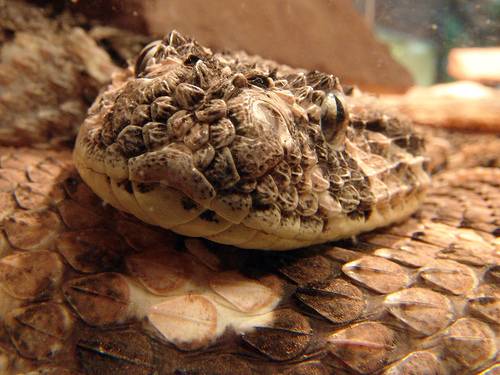
The puff adder, a chubby snake with gorgeous layered patterning, is one of the most prominent snake species in Africa. Found throughout most of the continent except central rainforests and the Sahara desert, it is also one of Africa’s deadliest snakes, reportedly responsible for the most cases of serious snakebites in this country.
The puff adder is bad-tempered but, like most snakes, will only strike as a last resort.
“Venom production is extremely costly,” explains Francois. “Wasting this precious protein and not gaining from it would be a great loss to any snake.”
When approached, a puff adder will make a sluggish retreat while warning the transgressor of its presence through a continuous hissing sound, and only when pressed will it move away with surprising speed, or attack from an S-shaped defence posture.
Interestingly, the young are far more dangerous as they have not yet learned how to control their venom output, meaning they inject most of their yield into a victim. Francois adds that, being a potential “drive-through snack” for any predator, youngsters are generally afraid of everything and thus maximise their attack.
A typical puff adder has a venom yield of about 130 to 750mg, where 100mg is enough to kill a healthy adult male. In their book A Guide to the Reptiles of Southern Africa (2007), Graham Alexander and Johan Marais explain that the puff adder’s diet consists mainly of rodents, but that they won’t turn down any suitably sized mammals, birds or lizards, and will avoid damage from larger prey by releasing them after the first bite.
According to Francois, these snakes are also world record holders. A female puff adder was reported to have given birth to 156 young in a Czech Republic zoo (where the norm is 50 to 60), being the largest reported litter for any snake species.
Rattlesnake (Sistrurus)
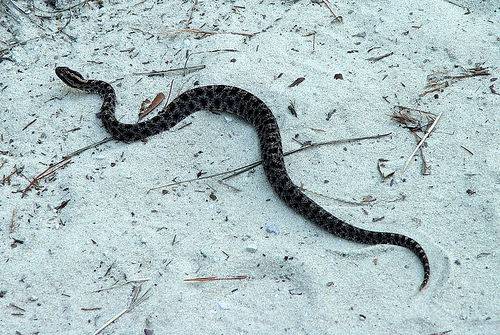
What comes to mind when you hear the word rattlesnake? Does it go hand-in-hand with images of tumbleweeds blowing through a dusty town in a Western movie? This distinctive and highly venomous snake is mostly found in the cowboy hometown of Arizona and dryer regions of Mexico, and falls under the broader category of pit viper along with about 30 other species.
All are characterised by a triangular-shaped head and the famous rattle found at the end of their tails, used to sound an effective warning bell to ward off predators. This rattle consists of a series of hollow beads, formed of shed skin, which beat against each other to create that unmistakable sound (you can listen to the rattlesnake’s warning on Wikipedia).
Baby rattlesnakes are not born with a rattle, but rather form it over time, generating a rattle segment every time they shed. Francois says they are awesome creatures.
“Rattlesnakes have nerve endings in heat receptive pits on their face, which enables them to see in infrared. They don’t need their eyes at all to hunt prey at night.”
According to website DesertUSA, the snake’s forked tongue is also able to pick up microscopic airborne particles and gases from the air. When placed back in its mouth, the tongue brushes against a sensitive area on the roof of the mouth known as the Jacobson’s organ, which identifies these particles as either food, threats or potential mates.
Unlike most other snake species that lay eggs (oviparous species), a female rattlesnake’s eggs hatch inside her, and she gives birth to live young (she’s ovoviviparous), who are ready to fend for themselves on day one.
Rattlesnakes can strike from a distance of two-thirds their own length (usually over 1m), and roughly 25% of recorded bites from the snake have been dry, with no venom injected. Francois adds that, because the rattlesnake is an exotic species, South Africa does not produce antivenom for its deadly bite, which makes careful handling of the snake a priority.
Unfortunately, this amazing creature is a food source for humans in certain areas of southeast and southwest America, and is sold in certain specialty meat shops.
Cape cobra (Naja nivea)
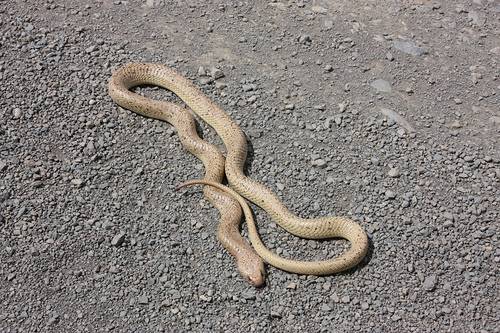
Unlike its cousins the spitting cobra and the rinkhals, the Cape cobra cannot spit venom at all, and rather relies on a lightning-quick strike to handle prey. Like the puff adder, Cape cobras are responsible for a majority of human deaths from snakebites in South Africa because of their readiness to bite if aggravated.
Francois admits that cobras are his favourite species of snake, and says he looks forward to introducing them at the snake demonstration at the Aquarium next month. “The Cape cobra is a bit of an obsession for me, just because of the way they spread the hood on their necks as a warning.
“Like the rattlesnake and puff adder, the Cape cobra is extremely dangerous and deserves the same respect when handling. Their venom is about 80% similar to that of the black mamba.”
According to reptile experts Graham Alexander and Johan Marais in their book A Guide to the Reptiles of Southern Africa (2007), these snakes come in a variety of colours, the most notable of which is a bright lemon-yellow, but their colouration often matches their environment and can vary from a light sandy brown to a darker red-black.
Cape cobras inhabit much of the Western Cape and North West province, and extend out to the neighbouring eastern provinces, and Namibia and Botswana. They are terrestrial snakes, but often raid the nests of weavers in search of eggs, fledglings, or adult birds themselves.
They also adapt well to life in low-density suburbia, and don’t be surprised if you find them inside human dwellings on farms.