National Arbour Week runs from 1 to 7 September 2011. According to the Department of Agriculture, Forestry and Fisheries, the aim of the campaign is “to promote and create a better life for all”, which prompted the theme: “Forest for People”. There will be a special focus on promoting the planting and maintenance of indigenous trees in South Africa in an effort to sustain our incredible biodiversity.
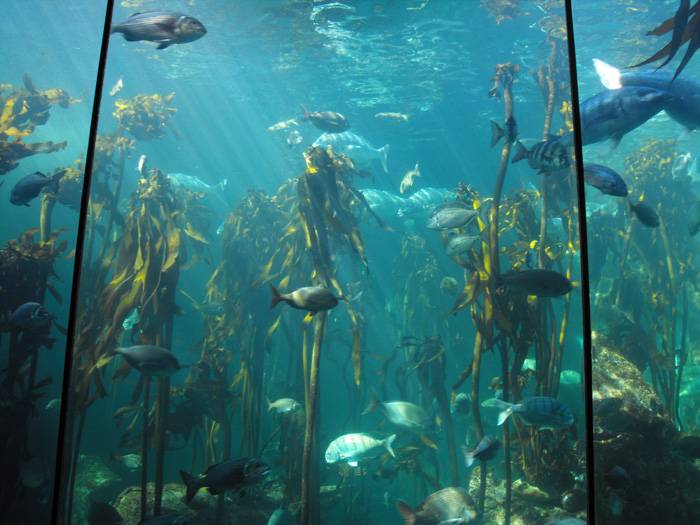
The term ”forestry” is traditionally divided into three different categories during National Arbour Week: indigenous forests, commercial forests and metropolitan forests. Two Oceans Aquarium can add a fourth category – underwater forests, as represented by our Kelp Forest Exhibit. Underwater forests play an equally important role in the relationship between humans and nature, with kelp not only being a versatile ingredient for man-made products but also but also contributing to our marine biodiversity.
Indigenous forests are important as they provide the trees and herbs used for natural remedies, provide a barrier against soil erosion and sustain the environment by supporting indigenous wildlife. According to the International Union for Conservation of Nature, “More than 70 000 plant species are used in traditional and modern medicine.”
Commercial forests are unnatural forests that provide people with jobs and wood for industry, while metropolitan forests refer to the trees, plants and lawns that are grown in cities and towns across the country.
Why plant trees?
Most of us know that trees are good for the environment and that without trees we would be unable to survive. Some may even recall biology lessons in which we were taught that trees take in carbon dioxide and convert it to oxygen. But how many trees do we actually need?
Saving trees is not only important from an environmental perspective, but is integral to the survival of the human species by virtue of trees’ filtration function and their economic contribution.
A mature leafy tree produces as much oxygen in a season as 10 people inhale in a year. The forest also acts as a giant filter that cleans the air we breathe by intercepting airborne particles, reducing heat and absorbing pollutants such as carbon monoxide, sulphur dioxide and nitrogen dioxide. Trees remove this air pollution by lowering air temperature, through respiration, and by retaining particulates.
According to the World Wildlife Fund, around 10-million people are employed in forest management and conservation globally. Locally the Government Communication and Information System (GCIS) states that forestry is an integral part of our economy in terms of job creation.
According to the GCIS South Africa has developed one of the largest planted forests in the world, with 178 primary wood-processing plants, 174 of which are owned by the private sector and four of which are owned by local and state authorities.
“The total roundwood intake into these processing plants in 2007 was 19,8-million m3 with a value of R5,2-billion. The value of sales of timber products produced by these primary processing plants totalled R18,5-billion. Some R15,8-billion was invested in primary roundwood-processing plants (at book value). At market value, this increased to an estimated R40-billion,” the report states.
An underwater forest
Kelp forests resemble their earthbound counterparts, growing underwater like tall trees. These marine forests comprise some of the most species-rich ecosystems on the planet. They support marine biodiversity and provide an essential nursery for fish species and sanctuary for urchins, rock lobsters and other smaller creatures
South African kelp forests flourish in the icy waters of the Atlantic Ocean, from Cape Agulhas to central Namibia, where nutrient upwellings sustain the plants.
There are only three kelp forest exhibits in the world, one of which is at the Two Oceans Aquarium. This underwater wonderland – which may be explored by experienced divers – has been described as an indoor “Atlantis” that provides a window to a mesmerising underwater world.
Commercially kelp has been used as a medicine, as a fertiliser and agricultural growth stimulant, and for the prevention of soil erosion. It is also dried and crushed to produce alginate, a gel used in toothpaste, ice-cream, pizza toppings, beer, jelly, salad dressings, flavoured milks, cosmetics, paint and ink. Pet food, dental moulds, clothing dyes and even explosives also contain this valuable resource.
For an unforgettable experience, transform yourself into a sea urchin, book a dive and swim through our forest while feeding the fish.
Back on land this Arbour Week, be sure to do your bit for the environment by planting an indigenous tree such as the jacket-plum (Pappea capensis), the tree of the year for 2011.
Stay in touch: For daily Aquarium updates, follow us on Twitter (@2OceansAquarium) and become a fan on Facebook.
{download_matrix}