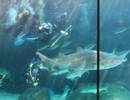
Two large ragged-tooth sharks, which were destined for release from the Two Oceans Aquarium back into the wild at the end of March 2007, have died in an unexpected turn of events. Aquarium staff were greeted on Monday morning with the tragic news that Bella had died during the night and the second shark, Billy, had to be euthanised late on Monday afternoon.
This was not the plan,said Michael Farquhar, the Aquarium’s Curator. We are devastated to have lost two sharks, which have been with us for almost ten years. Monday was a very sad day for all of us. Bella and Billy were removed from the I&J Predator Exhibit on Tuesday 6 March 2007 in preparation for their release back into the oceans as part of the Save Our Seas Foundation M-Sea Programme, which is an AfriOceans Conservation Alliance (AOCA) initiative in collaboration with the Two Oceans Aquarium.
Removing large sharks from the Exhibit is not an easy task and to minimise the risk of injury to our staff as well as the sharks, we decided to use a sedative on the sharks before swimming them into a large transport tank on the surface,” said Michael Farquhar. There are no drugs which have been developed for specific use in sharks, however, we regularly use drugs which are used mainly in mammals, specifically dogs, cats and horses, and this particular sedative is no exception. The reason why we chose to use this sedative was because uShaka Marine World has recently used it successfully on its sharks. Once sedated, the sharks were removed from the exhibit and each underwent minor surgery to insert an ultrasonic tag into their body cavities and to prepare them for the attachment of a satellite tag. These procedures have been successfully conducted on numerous sharks, including Dee who was released from the Aquarium into the wild last year and a wild shark, Lesley, who was also caught, tagged and released last year as part of the SOSF M-Sea Programme.
The sharks were transferred to a temporary holding pool on the roof of the Aquarium where they were closely monitored by Aquarium staff. “The next day we were concerned about sharks well-being and in particular that of Bella initially. Whilst she appeared to be breathing normally, she lost colour and wasn’t moving. We tried to swim her, but she was unresponsive. It was almost as if she was in a coma, said Dr Patrick Garratt, Managing Director, who observed Bella over the weekend. Staff then noticed blood coming from her gills which indicated hemorrhaging. Although Billy was also not moving much, he appeared to be more responsive, but by mid-morning on Monday, he too was hemorrhaging from the gills. By late afternoon Billy was showing the same symptoms as Bella and we decided that the most humane course of action would be to euthanase him, said Michael Farquhar.
Autopsies conducted by Dr Tertius Gouws of Pathcare Veterinary Laboratory Services revealed a significant amount of blood in the heads of both sharks. Pooling of blood in one area is an indication that the body has gone into shock. It appears that their heart rates were lowered significantly and due to the fact that sharks are cold-blooded and have such slow metabolic rates, the blood was not circulating throughout the body. It is purely speculation at this stage, but initial findings point to the sedative as a possible causal factor in the death of both sharks. It is possible that the water temperature variances between the shark exhibits in Cape Town and Durban may have influenced the efficacy of the drug, said Dr Gouws. He will conduct further tests on tissue samples from the organs to verify the cause of death.
The Save Our Seas Foundation M-Sea Programme has already successfully tagged and released three Aquarium ragged-tooth sharks (Maxine, the icon of the Programme, in 2004, Val in 2005 and Dee in 2006) and two wild sharks, Sam in 2005 and Lesley in 2006. Further, over one hundred million people worldwide have been exposed to this high profile public awareness programme over the last three years through teacher training workshops and exhibits at the Two Oceans Aquarium; a television documentary broadcast on 50/50; three Rethink the Shark television commercials screened internationally; the AOCA website and through extensive media coverage.
The deaths of Billy and Bella are a tragic loss for us especially given the success of the SOSF M-Sea Programme to date. Worldwide this unique shark conservation programme has gone a long way to changing people’s perceptions of sharks as well as to contributing significantly to our knowledge of ragged-tooth sharks, thus assisting in their conservation, said Lesley Rochat, AOCA Director and the Programme’s Leader. What we are learning from our research, along with the Programme’s extensive education and awareness success, far outweighs the setback caused by the loss of our two sharks, she continued. As such the Save Our Seas Foundation M-Sea Programme will continue this year with the satellite tagging of two wild ragged-tooth sharks at the end of March, while plans will be made for the satellite tagging and release of another Aquarium shark in the future, said Rochat.
The satellite technology used by the Programme has allowed the team to gain greater knowledge and deeper understanding about these animals, putting them in a better position to protect and conserve sharks for the future.