Talitha Noble is still a volunteer at the Aquarium, having started as a Young Biologist in 2007. She has graduated from the University of Cape Town with a Bachelor’s degree majoring in Marine Biology and will be starting her Honours this year.
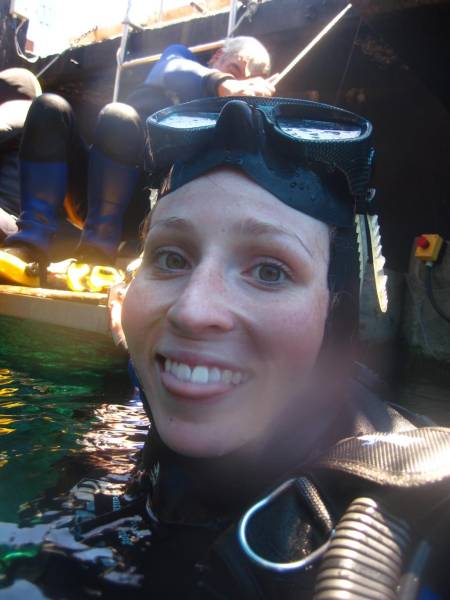
As you get older, you have more of life to look back on. As I grow up (and am still growing up) I realise, more and more, that doing the YB course was one of the best decisions I have ever made.
But it all started when I was in Grade 10. We got this very big science project; to pick any topic and run a monitoring programme. Like real scientists we would have to set up an experiment, observe changes, take notes and come to conclusions. Having been in love with the magical ocean since I was a little girl, it was obvious that I was going to do something that was all about the sea. So I picked the topic “How global warming is affecting coral reefs”. I had no tank at home, didn’t know how to get hold of coral and had absolutely no knowledge about how to care for them. So I contacted the Aquarium and got to meet with Bianca, Russell and some of the aquarists. With their help, a tank in the upstairs classroom, a chunk of coral and ample enthusiasm, I started my project.
Over the next months I came in twice a week to siphon, monitor and to slowly start increasing the water temperature in the hope that the coral would start to bleach as it became stressed. My goal was to find the threshold temperature at which the bleaching would occur. But alas, I think I raised it to 32 degrees without any changes occurring – not realising that I had picked one of the toughest and most temperature-resistant corals. So that didn’t quite work out as planned.
The experience, though – of being in this place, of having all these passionate and friendly people around me, of being among such beautiful creatures, of getting my toes wet – it was like showing a little kid Willy Wonka’s factory, and under no circumstances was I going to leave.
So I signed up for the YB course which was a few months away, and patiently waited for the end of the year to come. Doing the YB course was the most exciting, tiring, wonderfully overwhelming experience. Back in the day, the course was run in the first week of the December holidays, right after the school year had ended. So we were all quite tired from exams – and then bam! EARLY MORNING LECTURES, TESTS, MEMORISING FISH NAMES, OUTINGS TO ROCKY SHORES, EXCITING NEW PEOPLE, A CAMP FULL OF ADVENTURES, INCREDIBLE EXPERIENCES AND PASSIONATE TEACHERS! It all happened so quickly and I learned so much.
One thing that I realised over the course of becoming a YB, was that I had a deep-rooted passion and love for the ocean and all her creatures. I didn’t mind staying up late learning, I wanted to come in every day through my vacation to do my hours. I wanted to tell people about the incredible wonders found along our coastline, at the microscope and touch pool – despite the aching back and cold hands. This passion was going to be very important in the years to come.
After I had done my 100 hours front of house, I started behind the scenes. This was both super-exciting and slightly nerve-wracking. There were all these new people in dark blue shirts, all these corridors, rooms, tanks, slippery floors. There were pipes, loud noises, chaos, diving gear and wetsuits. The smells of C grade pilchard, leftover squid and rotting kelp were daily ones.
It very quickly became my favourite place.
I spent every holiday and most of my gap year at the Aquarium. I learned how to epoxy pipework, how to fillet pilchard and feed spider crabs. I learned to identify the penguins and sharks by name, how to keep kelp wet on collection trips and how to not let crickets escape when feeding them. I cleaned hundreds of tanks, watched, learned and helped as animals were medically treated, moved, collected and released. I was taught to be flexible, to hurry up … and then wait, to learn from my mistakes and to ask lots of questions. There were many days when my mom would fetch me after work and make me sit on a towel in the car, with the window rolled all the way down, because the stench of squid was so strong.
The longer I spent at the Aquarium, the more experience I gained and the more responsibility I was given.
The next part of my adventure involved tertiary education. As a student who works hard but doesn’t always do very well in test/exam situations, I was slightly shocked, very overwhelmed and quite nervous when I heard that I had been accepted to study Marine Biology and Conservation Biology at the University of Cape Town. It turned out that this was for good reason.
First year of a science degree nearly broke me. I spent many hours crying, failed many tests and survived many all-nighters simply to hand things in on time. I ended up spending the summer of 2011/2012 studying for supplementary exams to get into second year. And yet somehow I had motivation, and found the strength and drive to get up every time I fell down. Because as Einstein said, all you need to be is passionately curious. And I was. I was passionately curious and wanted to keep learning about this area of biology – so I persevered. This is the thing with failure; we think it defines us, when it simply exists to refine us. It is inevitable that we will experience failure in our lives – that we will work hard and that it will not pay off. Learning to keep moving forward is so important in those situations; it builds your character and makes you savour those times when all your hard work does eventually bear fruit.
In my second year, I was able to do something that I had wanted to do since my YB course – my commercial diving licence. I had saved for a long time and the chance to dive on collection trips, to do feeds and clean windows have again changed the way I see the ocean. To be able to interact with such majestic creatures so closely, to witness relationships and ecosystems first-hand and to see the obvious human impact on our seas, has stitched the ocean even closer to my heart.
Then, at the beginning of this year, I got the opportunity to do a project with one of the Aquarium’s researchers, Deborah Robertson-Andersson, a project on turtles. Every year the Aquarium recovers baby loggerhead turtles that wash up on our beaches. These little reptiles hatch on the shores of northern KZN and once at sea, get caught in the south-flowing Agulhas current. We then rehabilitate these turtles and release them back into the wild once they are older and stronger. The Aquarium has been doing this for the past eight years. With Debbie and one of the aquarists, Kevin Spiby, we have written up a report, looking at the timing, location and size of turtles as they wash up – hoping that it might give us insights into this first year of a turtle’s life, thereby contributing to the conservation of this endangered species. This project, too, has had and is still having many ups and downs, and has given me many opportunities to grow as a biologist.
So here I stand, at the end of my university degree, six years into my adventures with the Aquarium, incredibly excited about the future and still utterly driven. If there’s one thing that I’ve learned on this journey so far, it’s that our oceans need protecting. There is such a lack of understanding regarding the seas. We exploit it and take it for granted, and don’t comprehend how essential it is for our survival. As one of my lecturers, Colin Attwood, says: when it comes to the ocean we take off our cloak of responsibility, we treat the sea with a different set of standards – and this needs to change.
Learning about these ecosystems and various species gives us the responsibility to impact such change. This burden and passion for the seas and surrounding diversity is going to drive us to be the game-changers, the educators and the role models. We will be the young biologists who have an impact, who lead by example. The Aquarium you see, is breeding ambassadors – to save and protect these wonders of existence that are found in our seas, and which we have the privilege of interacting with so closely.
I am so indescribably grateful to the Aquarium for the opportunities it has afforded me. It has been a platform to learn and gain experience, to meet incredibly passionate and dedicated people in the marine field. It has opened up doors, for my project, to dive, to interact with marine life in ways that I would otherwise never be able to, and to create connections around the world. And to think that it all started with a project and YB course in the 10th grade.
Marine biology and conservation is my niche. But I am aware that it might not be yours. You are, however, all biologists, and so have the opportunity and responsibility to share that which you have learned with others – to make your classmates, your family, your friends aware of the natural beauty that surrounds them and the urgent need that exists to protect it.
So I would just like to end with a quote that inspires me in this regard, as I hope it inspires you:
“It seems to me that the natural world is the greatest source of excitement, the greatest source of visual beauty, the greatest source of intellectual interest. It is the greatest source of so much in life that makes it worth living.” – David Attenborough
Thank you so much for listening, congratulations on graduating and good luck for the future.
If you would like to become a Young Biologist at the Two Oceans Aquarium, we have a course taking place in the April holidays 2014. You can apply online! For more information, please e-mail education@aquarium.co.za or call 021 814 4555.