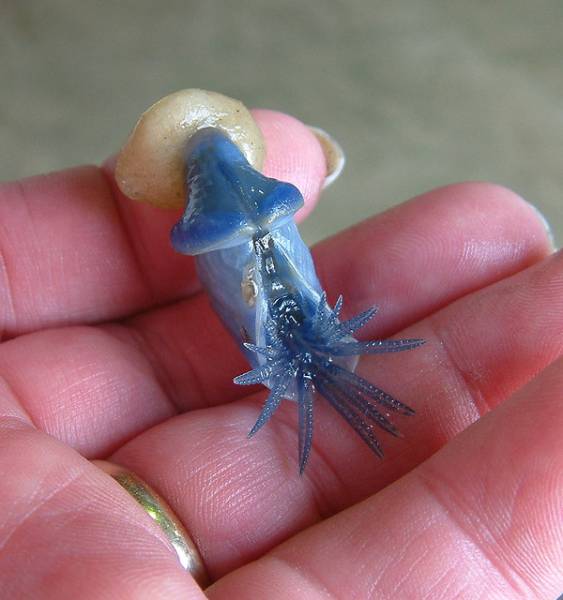
This interesting little guy, known as the buoy goose barnacle, is being spotted more frequently along Cape shorelines lately, and seems to be giving some beachgoers goosebumps. We’ve had a few calls and queries, and one of our sea fans, Kathy Lloyd, posted a picture of the crustacean on our Facebook wall, asking us to identify it.
We’re more than happy to help quell some of the curiosity surrounding the buoy goose barnacle (Dosima fascicularis), a very rare visitor in to South African waters.
This barnacle hangs downwards from the water surface, and is held up by a self-made float (or buoy), drifting along with the ocean currents. According to Wikipedia, they prefer temperate seas like the Pacific and Atlantic Oceans, and have been seen floating from Japan to the Hawaiian Islands. They sometimes wash up on westerly and southerly beaches in the British Isles, and have been found further south in Europe.
Habitat information
The Marine Life Information Network explains that the buoy goose barnacle young (cyprid larvae) are planktonic, and must attach to a float for metamorphosis into adult form.
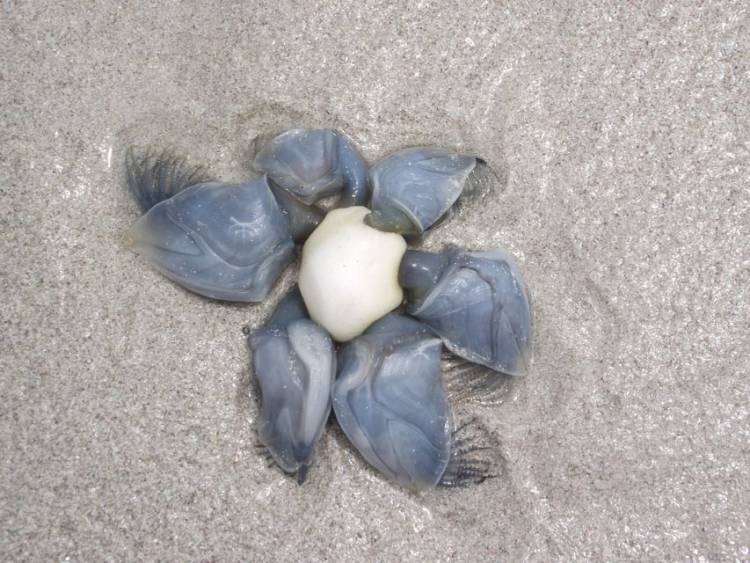
“They usually settle on small floating particles in the water, and as they grow they produce a spongy secretion from modified cement glands, comparable in texture to polystyrene, which keeps them near the surface of the water and is increased in volume as the barnacle grows. Other individual barnacles attach to the float and in this way a large colony is constructed.”
The buoy goose barnacle can reproduce within 45 days, and appears to be increasing in abundance as a result of man-made marine debris accumulating in the sea, which could explain its increased occurrence in Cape waters.
According to the Marine Life Information Network, back in 1996, Dan Minchin of Marine Organism Investigations in Ireland “suggested that strandings of the buoy goose barnacle are greater nowadays as a result of extra nuclei available for settlement in the form of man-made plastics and oil globules”.
Stay in touch: For daily Aquarium updates, follow us on Twitter (@2OceansAquarium) and become a fan on Facebook.